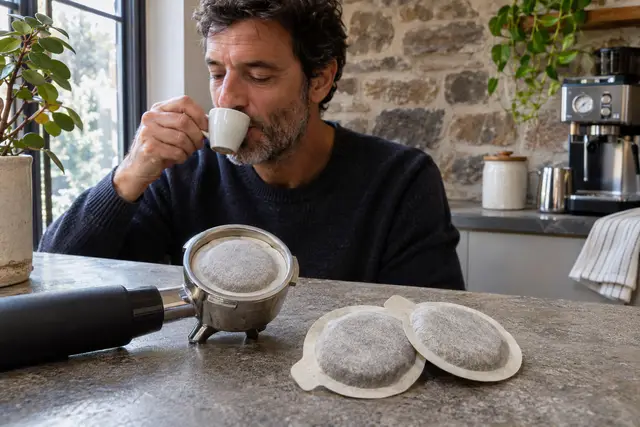
A coffee pod machine for 38 mm ESE pods is a pump-driven espresso appliance whose pod housing is advertised with a reduced diameter of thirty-eight millimetres, smaller than the paper pods of the E.S.E. standard, which is set at forty-four millimetres. It uses a round of ground coffee pressed into filter paper, with hot water forced through under pressure. This small size mostly concerns compact appliances and adapter baskets, and it means you must check the exact dimension carefully before buying any pods.
A size outside the standard
The E.S.E. standard describes a forty-four-millimetre pod containing about seven grams of coffee. A diameter of thirty-eight millimetres departs from it by six millimetres, a difference big enough that a standard pod will not fit a housing designed for a smaller size, or will float about in a basket that is too wide.
The thirty-eight-millimetre figure turns up on product sheets to describe a basket, an adapter or a small-format pod. The name of the format therefore guarantees nothing: only the real diameter of the housing, taken from the manual or measured with a ruler, can be trusted.
Measure before you buy
Take out the portafilter, find the basket and measure its inside diameter at the bottom, where the pod rests. A graduated ruler or a calliper is enough. Note the depth of the basket too: a thick pod needs enough height for the portafilter to lock without crushing the paper.
Then compare with the pod packaging. The diameter is usually printed on the box; if in doubt, ask the seller for the exact diameter in millimetres rather than the name of a format.
How a small basket behaves
In a narrower basket, the round of coffee is thicker for the same amount of grounds. The water then takes longer to pass through, and the extraction can run too long if the grind is very fine. Conversely, a pod that is too thin in a wide basket lets water through at the edges and gives a pale coffee.
The pump supplies the same pressure of about nine bars at the coffee, but the way the water is spread varies with the contact surface. A small basket therefore calls for a well-calibrated pod.
Adapters and reducers
Some manufacturers sell a reducer that slips into a large basket to take a smaller pod. This accessory must follow the walls closely: a badly fitted reducer leaves a gap through which water escapes without passing through the coffee.
- A clean, well-seated reducer ensures an even extraction.
- A reducer that is cracked or warped by heat must be replaced.
- An improvised adapter made from aluminium foil is to be avoided: it blocks the water flow and can overheat.
Flavour and crema
A smaller amount of coffee in the pod gives a lighter espresso. To make up for this, some users stop the flow earlier, at around twenty seconds, to keep some body. They get a shorter, more concentrated coffee, with a decent crema if the pod is fresh.
A very fine grind and tight paper favour crema, but the slightest excess leads to bitterness. It is best to try two or three different boxes before settling on one.
Cleaning a small-size basket
A narrow basket holds on to grounds and coffee oils more readily. After each cup, remove the pod, rinse the basket in hot water and run a soft brush over the grid at the bottom. Once a week, soak the portafilter in hot water with a product suited to coffee machines, then rinse at length.
Blocked perforations can be cleared with a fine needle, without forcing it, since they serve to spread the water.
Descaling and water
Water hardness is a major factor in a machine's lifespan, whatever the size of the housing. Hard water leaves scale in the boiler and the pipes. Descaling every two to three months is common, and more often in a very hard-water area. Follow the manual: some machines require a specific product.
Filtered or lightly mineralised water spares the circuit and gives a cleaner taste, without an excess of minerals.
Budget
Small-size machines are generally more compact and lighter, with a modest entry price. The extra cost lies elsewhere: a narrower choice of pods, sometimes sold singly or in small boxes, pushes up the price per cup. Compare it with the cost of ground coffee bought in a packet, which is far cheaper in use.
Storing the pods
Keep them in their individual sachets for as long as possible, at room temperature and out of the light. A small-format pod holds less material, so its aroma fades faster than that of a standard pod once in the open air. Use it within the hour after opening.
Sorting the waste
The paper and the grounds are organic matter. A pod certified as compostable can go into the compost bin or the food-waste bin if the local council runs one; otherwise it goes in the household rubbish. Plastic sachets follow local sorting instructions, which the council waste service can explain.
Precautions
Never force the portafilter lock with a pod that is too thick: the pressure of the pump can spray hot water. Let the pressure drop before taking out the basket, and keep the machine away from children. Do not put any accessory the manufacturer has not provided for into the hot-water circuit.
What if the pods do not fit?
If the diameter of the pods differs from that of the basket, there are two solutions. The first is to choose a basket of the right size, often sold as a spare part. The second is to switch to ground coffee with a loose-grounds basket, which you dose yourself, at around seven grams for a single espresso.
A third route is to change machine for one that takes the forty-four-millimetre standard, which has a wider supply of pods from every origin.
Does a 44 mm pod fit a smaller housing?
No, it folds or will not close; do not force it, as you risk damaging the seal.
Does the taste change with the diameter?
It changes mainly with the amount of coffee and the fineness of the grind, more than with the diameter itself.
What is it best used for?
A small-size machine suits a person living alone who drinks one or two espressos a day in a limited space. It is easy to store, easy to carry and uses little power. It is less relevant for a large household, which will find more choice and flexibility with the most widespread standard.
Grind and dosing in a reduced basket
When you fill a small basket yourself with ground coffee, the rule is to tamp without crushing. An even pressure of about fifteen kilos with a tamper gives a uniform puck. Tamping too lightly creates channels where the water races through without extracting, while tamping too hard blocks the pump and raises the pressure in the circuit.
The grind is set on a fine scale, close to icing sugar without being flour. If in doubt, start from the grind of a packet meant for espresso and adjust in small steps, timing the flow.
Classic buying mistakes
- Trusting a format name without reading the diameter given in millimetres.
- Buying a large number of pods before trying a small box.
- Mistaking the sixty-millimetre soft pod for a rigid pod, which will not work in any small-size basket.
- Neglecting the condition of the brewing-head seal, which lets water leak at the sides.