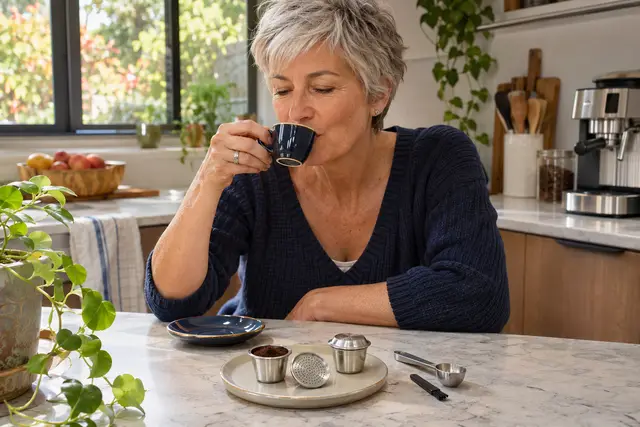
A refillable coffee pod is a small reusable holder, made of stainless steel, food-grade plastic or silicone, which you simply fill yourself with ground coffee before placing it in the machine. It replaces the disposable pre-filled pod: instead of buying a sealed portion, you choose your own grind, quantity and blend. It suits enthusiasts who want to cut waste, control their budget and personalise their cup, provided they respect the diameter and the type of machine it was designed for.
Materials and shapes available
Reusable models fall into three main materials. Food-grade stainless steel dominates the rigid versions: it withstands heat, does not retain aromas and is easy to clean. Lighter, BPA-free food-grade plastic suits smaller budgets, but it can warp over time under the effect of pressure and temperature. Flexible silicone, finally, is mostly used to make baskets or cups that follow the shape of the portafilter.
The shape depends on the system you are aiming at. For machines that take soft 44 mm pods, known as E.S.E., you will find a small circular basket with a perforated base, closed by a disc or a snap-on lid. For small-format capsule machines, the refillable version looks like a cylindrical cup with an aluminium lid or a reusable seal. The two families are not interchangeable: a capsule cup does not slide into a pod holder, and vice versa.
Checking compatibility before you buy
The first reflex is to measure. On a machine that takes paper pods, the seat in the portafilter is calibrated for a diameter of around 44 millimetres. If the holder is wider, it will not fit; if it is narrower, the water bypasses the coffee and the extraction turns watery. Also note the height available under the piston or under the machine's grille, because a basket that is too tall prevents the lever from closing.
A second criterion concerns pressure. A pump-driven espresso machine tolerates finely perforated baskets, whereas a low-pressure pod machine works better with wider perforations. Machine manuals generally state the format accepted; failing that, the maker of the holder specifies which systems are supported.
Which grind to choose
The grind determines the whole result. For a basket intended for a pressure machine, you want a fine but not powdery grind, close to that of a classic espresso. A grind that is too fine blocks the perforations, slows the flow and gives a bitter drink; a grind that is too coarse lets the water through too quickly and produces a thin, sour coffee with no body.
The simplest approach is to buy coffee that is already ground for espresso, or to grind it yourself just before filling. In the latter case, a burr grinder lets you adjust the particle size finely, which a blade grinder, being more approximate, does not. A few trials are enough to find the right setting with your machine.
Dosing and filling step by step
A standard soft pod contains about seven grams of coffee, according to common manufacturer practice; a refillable holder often takes a little more, between seven and nine grams for one cup, depending on its capacity. It is best to weigh the first doses with kitchen scales accurate to the gram, then mark the level with the measuring spoon supplied.
- Fill the basket level to the brim, without overflowing.
- Smooth the surface with the back of a blade or a clean finger.
- Tamp lightly with the tamper supplied, using a vertical, even movement.
- Wipe the rim so that no coffee grounds interfere with closing.
- Place the basket in the portafilter, then lock the lever.
Tamping should be neither absent nor excessive. Too light, and it leaves preferential channels for the water; too firm, and it blocks the flow and can raise the pressure to the point of triggering a safety valve.
Taste and consistency
The great advantage of filling at home is freedom of composition. You can combine a pure arabica coffee, a blend with a share of robusta for more crema, or a decaffeinated coffee for the evening. You can also vary the strength by adjusting the dose, one gram more or less, without changing machine.
In return, consistency demands a little discipline. An industrial pod is identical every time; a pod filled by hand depends on the gesture. By always weighing and tamping in the same way, however, you obtain results that are very close from one cup to the next.
Cleaning and maintenance
After each use, empty the grounds into the compost bin or the rubbish bin, then rinse the basket in hot water. A soft brush dislodges residues stuck in the perforations. Once a week, soaking for a few minutes in hot water with added bicarbonate of soda removes the coffee oils that turn rancid and give a bitter taste.
Avoid abrasive sponges, which scratch the stainless steel or plastic and encourage deposits to cling. Let it dry completely before putting it away: residual damp can cause mould in the corners of the lid. Finally, check the condition of the seal or the collar: a worn seal lets water leak out at the sides.
Budget and payback
The sum is simple. A refillable holder costs from a few pounds to around twenty, depending on the material, and pays for itself after a limited number of cups, because packet ground coffee works out much cheaper per cup than the pre-portioned version. You should, however, add if necessary the price of a tamper, a grinder or a set of scales.
Payback therefore depends on consumption. For someone who drinks one or two cups a day, the annual saving becomes noticeable; for occasional use, the advantage is more environmental and a matter of taste than financial.
Ecology and waste
A disposable pod creates a small item of waste with every cup: filter paper, sometimes a plastic wrapper, possibly a metal seal. The refillable model eliminates the individual packaging and leaves only the grounds, which can be put to use in the garden or the compost. Its lifespan, several hundred uses for a good stainless steel one, more than offsets the energy needed to make it.
Ground coffee in a large packet or sold loose also limits packaging. To extend this gain, it is better to buy bags of a reasonable size and to reseal them carefully after each use, to avoid oxidation.
Limits and precautions
The refillable pod is not a universal solution. Some machines recognise the disposable capsule by a particular code or shape and refuse the reusable holder. Others require a precise piercing of the seal, impossible to reproduce with a home-made cup. Before giving up, consult the machine's manual and, if need be, the maker of the holder.
For safety, never force the lever closed if the basket resists: remove it and check the quantity of coffee. Let the machine cool before handling metal parts, and never pour scalding coffee into a plastic basket not designed for it.
Can you mix several coffees in the same holder?
Yes, nothing forbids it, provided you respect the total dose. Mixing a strong coffee and a mild one in the same basket gives a cup in between. Note down your proportions so that you can reproduce them.
How long does a refillable basket last?
A well-maintained stainless steel basket lasts several years. Plastic wears out faster, especially in a high-temperature dishwasher. Replace the part as soon as it cracks or warps.
Tips for getting started
Begin with a single grind setting and a fixed dose, then change only one parameter at a time. If the cup is too bitter, loosen the grind or reduce the tamping; if it is too thin, do the opposite. After a few cups, you have a personal recipe that is stable and easy to reproduce, which saves you buying disposable pods while keeping the pleasure of a coffee prepared in a few seconds.