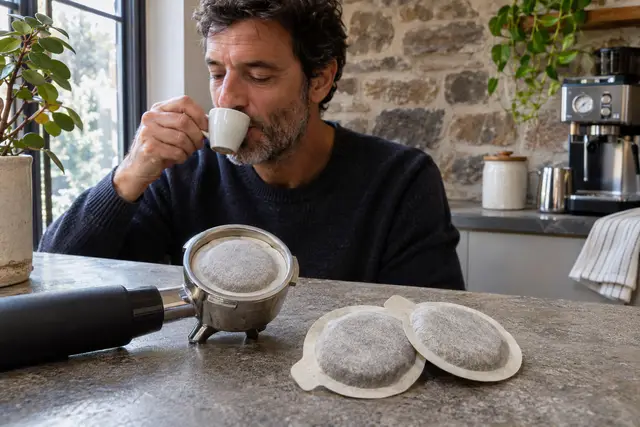
A coffee pod for a manual espresso machine is a portion of ground coffee, wrapped in filter paper, placed in the basket of an appliance where the user controls part of the extraction personally, by a lever, a button or a manual stop. It simplifies preparation by removing the dosing and tamping, while leaving control of the volume. It is aimed at people who enjoy the craft of making coffee but do not want to grind or weigh for every cup.
What 'manual' means
The term covers several families of appliance. The lever machine, the oldest, uses the strength of the arm to force water through the coffee. The semi-automatic pump machine lets the user start and stop the flow, but the pressure is supplied by a motor. Finally, some small travel appliances work with a hand pump, without electricity.
In every case, the pod must be chosen to suit the basket and the pressure available. A travel appliance with a manual pump reaches more modest pressures than an electric kitchen machine, and pods that are too dense give a flat coffee there.
Choosing the right format
The soft 44 mm pod, to the E.S.E. standard, is the most widespread on manual kitchen machines. Its paper lets water through evenly, and it fits a basket designed for it. For a portable appliance, smaller portions or finely ground coffee, dosed yourself, are often preferable.
To avoid disappointment, note the diameter of the basket, check that it accepts a soft disc and read the maximum pressure stated. If your appliance says 'ground coffee only', the pod is not made for it.
The technique, step by step
- Preheat the appliance and the portafilter by running a little water through.
- Place the pod in the centre of the basket, smooth side up.
- Check that it lies flat, with no fold at the edges.
- Lock the portafilter without forcing it.
- Start the extraction, then watch the flow.
On a lever model, lower it in a slow, continuous movement. Too fast a descent makes the pressure climb abruptly and the coffee turns bitter; too slow a descent cools the water and weakens the aromas.
Controlling the volume
The great appeal of a manual machine is control over the quantity. A short espresso is prepared in a few tens of millilitres; stop the extraction when the colour of the flow changes from dark brown to pale beige, a sign that the aromas are spent. If you want a longer cup, add hot water at the end rather than prolonging the passage through the coffee.
With experience, you learn to spot the right moment by ear and by eye: a steady stream, the colour of dark honey, that stretches gently before lightening. This indicator is better than a stopwatch, because every machine has its own rhythm.
The most common faults
A flow that is too fast points to a basket too wide for the pod, a torn paper or a machine not heated enough. A flow that is too slow betrays a pod that is too compacted, a scaled shower head or a blocked grille. In both cases, the solution is a visual check of the basket, followed by cleaning.
A cup without crema may come from old coffee, a badly stored pod or insufficient pressure. Conversely, a coarse crema with large bubbles often indicates water that is too hot or coffee that is too fresh and still rich in gas.
Temperature and preheating
On a lever machine, the water is heated in a boiler or poured directly into the cylinder. A temperature that is too low produces a sour cup, one that is too high a burnt coffee. The ideal is around ninety to ninety-five degrees for brewing, a value commonly accepted by coffee professionals.
Preheating the portafilter and the cup matters as much as heating the water. Cold metal absorbs part of the heat on first contact, which lowers the brewing temperature by several degrees.
Maintaining a manual machine
Mechanical simplicity is an asset: there are few parts, and therefore few breakdowns. Rinse the basket after every use, dry the seal of the group head and occasionally lubricate the moving parts with a food-grade grease recommended by the manufacturer. Descaling remains necessary as soon as the water is hard.
Lever machines have a piston and a seal that wear with time. A hardened seal lets water leak along the piston, and the pressure no longer rises. It is easy to replace, often without any special tool.
Advantages and drawbacks
The main advantage is control: you feel the resistance of the coffee, adjust your movement and obtain a personalised cup. The appliance is often durable, repairable and less dependent on electronics. The pod adds consistency: same weight of coffee, same grind, same paper.
The drawback is the attention it demands. A manual machine does not stop the extraction by itself; it requires you to stay beside it, which suits less well those who make their coffee in a hurry before leaving.
Frequently asked questions
Is the pod suitable for a lever machine?
Yes, if the basket has the right diameter. The pod simply needs to lie flat and the appliance's pressure needs to be sufficient.
Should a pod be tamped?
No. The paper and the grind are designed to work without extra tamping. Pressing the disc damages it and slows the flow.
Can you use two pods for a double?
A single basket does not accept it. For a stronger cup, it is better to use a double basket, designed for two discs or for ground coffee.
Choosing your manual machine according to use
For daily use at home, a semi-automatic machine with a 44 mm portafilter remains the simplest choice: electricity supplies the pressure, and the user manages the start and stop. For a lover of mechanics, the lever machine offers a more sensory experience, at the price of a learning curve. For camping or an office with no socket, the portable appliance with a manual pump will do the job, with hot water prepared separately.
Before buying, check the availability of spare parts, in particular seals and baskets. A repairable appliance will stay with you for years, whereas a model whose parts can no longer be found becomes unusable at the first sign of wear.
Noise, size and comfort
A manual machine is generally quieter than an automatic model with a grinder, since it has neither a mill nor a high-powered pump. It also takes up less room on the worktop, but needs clearance above the group head to operate the lever. Measure the height under your cupboards before deciding.
As for comfort, an insulated handle and a drip tray of the right size make a difference every day. A tray that is too small overflows after a few cups, and an unprotected portafilter becomes scalding, especially at the end of a run.
Safety during preparation
Handle the portafilter with care: it holds very hot water and steam. Never remove it under pressure, let the appliance settle before opening it and keep children away from the worktop during use. In the event of a persistent leak, unplug the machine and have the seal checked rather than carrying on using it.
In practice
To succeed with a pod on a manual machine, you only need to bring together three conditions: a suitable format, a steady technique and a controlled temperature. The first attempts serve to learn the machine's rhythm; after a few cups, the movement becomes natural, and the pod frees the user from the work of dosing to leave only the pleasure of preparation.