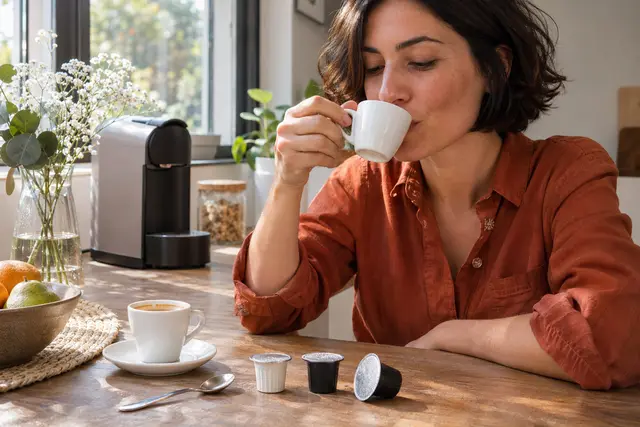
A coffee capsule machine for plastic capsules is an appliance that makes a drink from rigid plastic shells, often polypropylene, filled with ground coffee and closed by a lid. The machine pierces or opens the capsule, passes hot water through it under pressure, then ejects the empty container. This light format, cheap to produce, appeals to households looking for a coffee ready in seconds with a wide choice of varieties, but it raises the question of what happens to the shell at the end of its use.
What the shell is made of
The plastic in capsules is most often moulded polypropylene, sometimes combined with a thin barrier layer against oxygen. This layer protects the aroma, but it makes recycling more difficult because the stacked materials do not separate easily. A lid in aluminium or plastic film seals the shell.
Unlike aluminium, plastic lets a little more gas through over the months. That is why plastic capsules often carry a shorter best-before date, which should be respected to keep the drink true to its flavour.
How the machine opens it
Depending on the system, a needle pierces the lid on top, while the base is opened by the pressure of the water against a plate of spikes, or the capsule already has a small outlet. In some systems, the machine reads a code printed on the rim to adapt the time, temperature and volume to the drink.
This code reader is an advantage for varied drinks: the same machine automatically adjusts its programme for a coffee, a hot chocolate or a tea.
Plastic and heat
The shells are designed to withstand hot water at around ninety degrees for a few seconds. Used as the manual says, they do not warp. They must never be reheated in an oven or a microwave, and a capsule should not be left in an overheated place such as a car boot in summer.
Compatibility
As with all capsule systems, the shell belongs to one machine format. The dimensions of the rim, the depth and the way of piercing determine compatibility. A small plastic capsule will not sit in a machine built for a thinner aluminium shell, and the reverse is true too.
- Look for the system named on the packaging.
- Avoid forcing a capsule that will not click into place.
- Keep a sample before buying a large batch of compatible capsules.
Taste and drinks
Food-grade plastic does not pass any taste on to the drink if the capsule is intact and kept dry. Plastic capsules allow great variety: short and long coffees, powdered milk, hot chocolate and infusions. This versatility makes them popular with families of mixed tastes.
For milk-based drinks, plan to rinse the circuit after use: milk residue ferments quickly and leaves a sour taste.
Upkeep
Clean the capsule housing with a damp cloth, as the plastic shell sometimes leaves traces of grounds on the outlet grid. Empty the used-capsule bin before it overflows. Run a cycle of clear water after a sweet or milky drink.
Descaling needs to stay regular: follow the rhythm in the manual and use only the products it allows, because some harsh acids damage the rubber seals.
Purchase price and running cost
Plastic capsules are often sold more cheaply than aluminium ones, which eases the cost per cup. Their price is still higher than ground coffee and clearly higher than a paper pod. Check the price per capsule and not per box, since the number of capsules in a box ranges from eight to over a hundred.
The budget also includes descaler and, on some models, a water filter that is changed at regular intervals.
Storage
Keep the capsules in their box, somewhere dry, away from heat and strong smells. Even though plastic protects well against damp, it is better to use the capsules before the date shown. A capsule whose lid is swollen or peeling should be thrown away.
End of life and sorting
This is the weak point of the format. A used plastic capsule is a small object soiled with grounds, sometimes made of several materials. In many areas, collection has been widened to small plastic packaging, but the rule varies from one local authority to another and with the size of the item: a very small capsule can fall through the sorting belts and end up as reject.
Ask the council waste service. Some manufacturers and retailers take used capsules back, which allows dedicated recycling. Always empty the grounds before putting the shell in the bin, preferably into the compost.
Precautions
Never try to reuse a plastic capsule by filling it yourself without an accessory designed for the purpose: the seal is no longer assured and the pressure can spray hot water. Keep the machine away from young children and do not let it run without water. Let the shell cool before handling it.
Ways to cut down on waste
A reusable capsule in steel or silicone, filled with ground coffee, can be washed and used hundreds of times. A compostable capsule made from plant material avoids plastic but needs a suitable collection stream. The forty-four-millimetre paper pod leaves an organic waste that is easy to compost.
Can a plastic capsule be recycled with bottles?
Not always: the material differs from that of bottles and the fate of the capsule depends on local rules.
How long does a sealed capsule last?
The date printed on the box is what counts; it is generally several months.
Making the right choice
A plastic-capsule machine suits a household that values variety and speed, with no aim of cutting waste. Look at the range of drinks, the price per capsule and whether a take-back scheme exists. A machine that detects the capsule code brings convenience, but ties the household to a single system.
Settings and tips
Pre-heat the machine and the cup, use soft water and adapt the volume to the kind of capsule. A milky drink is made first with the milk capsule and then with the coffee one, following the system's instructions. Take the capsule out as soon as the cycle ends so that it does not dry out in the housing.
If the flow becomes uneven, clean the piercing head, then run an empty cycle again. An unusual pump noise often points to a tank that is not seated properly or a scaled-up circuit, two simple faults to correct.
Hygiene for milky drinks
Capsules of powdered milk or milk preparations call for stricter hygiene than coffee ones. Milk settles in the pipes and on the piercing head, where bacteria develop at moderate heat. Rinse with hot water after each milky drink, and wash the spout in soapy water once a day if use is frequent.
A sour smell or the taste of turned milk are warning signs: clean thoroughly as the manual says before the next drink.
Lifespan of the machine
A well-maintained capsule machine generally lasts several years. The wearing parts are the head seal, the pump and the piercing spikes. If the flow weakens despite descaling, have the seal replaced before changing the machine: it is an inexpensive part. Keep the manual, the receipt and the guarantee, which in principle covers manufacturing faults for two years.