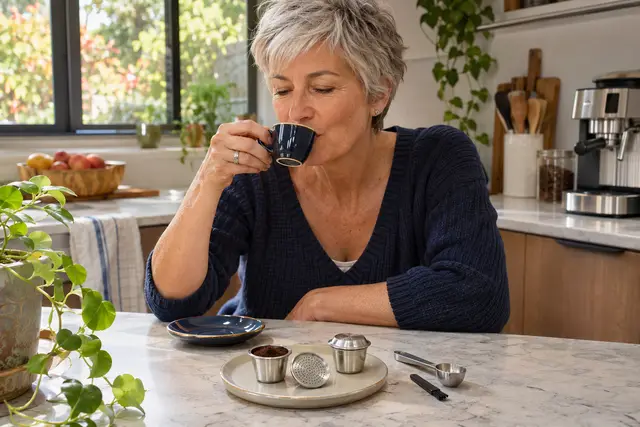
A coffee pod machine for refillable coffee pods is an appliance that accepts a durable pod, made of food-grade plastic, silicone or metal, which you fill with ground coffee before each cup instead of using a disposable paper pod. The refillable pod copies the diameter of a common format, for example forty-four millimetres, and sits in the portafilter or holder of the machine. It is for people who want to choose their grind freely, throw away less paper and bring down the cost of each cup.
A pod you fill yourself
The refillable pod is a small container with a perforated base and an upper part that compresses the grounds. Some are made of two discs that snap together, others of a cup with a built-in plunger that tamps the coffee as the whole thing closes. The aim is to reproduce the compact round of a paper pod, but with coffee chosen by the user.
The format must respect the diameter of the machine's housing. The most common diameter for pump machines is forty-four millimetres; low-pressure machines use a format of about sixty millimetres.
How it differs from the reusable capsule
A reusable capsule is a deep cup, pierced or opened by the machine. The refillable pod is flat and stays in the basket of the portafilter, like a paper pod. It is therefore never pierced, needs no special rim and comes out in one piece after the extraction.
This flat shape calls for a smaller dose, often six to seven grams, and a well-set grind so that the water passes through the round evenly.
Dosing and tamping
- Weigh out the target amount of finely ground coffee, around seven grams for a single espresso.
- Pour it into the lower part, levelling it flat with a finger or a small spoon.
- Put on the upper part and press down firmly, without crushing it out of shape.
- Place the pod in the basket, flat side down, and lock the portafilter.
Tamping too lightly gives an extraction that is too fast and a pale coffee. Tamping too hard blocks the flow: the pump hums and the coffee comes out drop by drop.
Setting the grind
For this format, the grind is close to that of a portafilter espresso. It should be even, without too much dust. If the water runs through in under fifteen seconds, make the grind finer; if it takes more than thirty-five seconds, make it coarser. These markers vary with the machine, the freshness of the coffee and the quantity used.
Coffee that was ground long ago runs fast and lacks crema: the ideal is to grind just before use.
Taste in the cup
With fresh coffee and a steady dose, the drink often matches that of a good paper pod, with a slightly paler crema. Choosing your own coffee opens up possibilities: single origins, small-batch roasts, decaffeinated blends, organic coffees. The aromas depend mostly on freshness and on water temperature, which should reach ninety degrees at the shower screen.
Materials used
- Stainless steel: strong, tasteless and easy to clean, but heavier.
- Food-grade plastic: light and cheap, it ages under the effect of heat and coffee oils.
- Silicone: flexible, it slips well into the basket, but holds on to smells if badly rinsed.
Always look for the food-contact mention on the instructions or packaging.
Cleaning
After use, take the pod apart, throw away the grounds, rinse in hot water and rub the grid with a soft brush. Leave the two pieces to dry separately: a pod closed while damp goes mouldy within days. A weekly soak in hot water with coffee-machine cleaner dissolves rancid oils.
If the perforations in the base get blocked, a fine needle will clear them gently.
Looking after the machine
Fine grounds eventually build up under the shower screen and on the seal. Wipe the seal with a damp cloth after each round of cups, and descale according to the hardness of the water. A scaled-up machine heats less and gives a paler crema, even with a perfectly filled pod.
Budget
A refillable pod costs a few pounds to buy and lasts several years. Packet ground coffee works out clearly cheaper than the same weight in pre-filled paper pods. The saving is greater the more regular the consumption. In return, preparation takes longer and a little discipline over dosing is needed.
Leaks and common faults
- Grounds in the cup: the pod is badly closed or the grid is too wide.
- Coffee running round the pod: the diameter is too small for the basket.
- A very slow flow: the coffee is too fine or too tightly packed, or the grid is blocked.
- No crema: the coffee is old or the water is not hot enough.
Keeping the coffee
Keep ground coffee in an airtight tin, at room temperature and away from the light. It keeps its qualities for a few weeks at most. It is better to buy small packets, or beans that you grind as you go.
Waste and sorting
Only the grounds are thrown away, which reduces waste. They go to the compost, the food-waste bin or the foot of the plants. No paper or plastic needs sorting with each cup, and the pod itself is discarded at the end of its life according to its material: metals to the recycling centre, plastic by local rules.
Safety in use
Always let the pressure drop before unlocking the portafilter. Do not fill the pod with anything other than ground coffee and do not heat it outside the machine. Keep small parts out of the reach of children, who could swallow them.
Is a special machine needed?
No, but the diameter of the pod must match the basket of the machine, which can be checked in the manual.
Can decaffeinated coffee go in?
Yes, and it is one of the attractions of the system: you pick the coffee to suit the time of day.
Making the right choice
Keep three criteria in mind: a diameter that suits your basket, a sturdy closure that withstands the pressure, and simple cleaning. Two-piece models with a removable grid wash better. Avoid unbranded products with no food-contact mention, whose quality is uncertain.
Finally, test the result with several coffees before settling: it is the grind and the freshness, far more than the accessory, that make a good espresso.
Two formats, two uses
The forty-four-millimetre format is used with a pump and gives a short, dense espresso topped with crema. The wider soft format is used with a low-pressure machine and gives a long, mild coffee with a light froth. In both cases the refillable pod must respect the thickness of the round: a model that is too deep leaves a gap above the coffee, where the water swirls instead of flowing evenly.
An adjustable model, whose plunger alters the internal volume, suits people who change dose regularly, for example between a single and a double espresso.
Travelling and using it at work
A refillable pod travels easily with a small bag of ground coffee and a measuring spoon. In an office or a holiday home, it saves storing bulky boxes. Just bring a watertight container for the grounds and a cloth to wipe the basket: damp grounds quickly leave stains on a worktop.
For shared use, give each person their own pod to avoid mixing flavours, especially between regular and decaffeinated coffee.