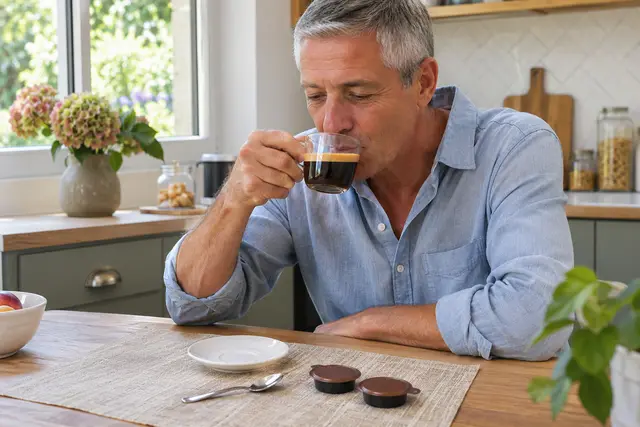
A coffee pod machine for low-pressure pods is an appliance that gently passes hot water at moderate pressure, in the region of one bar, through a soft filter-paper pod containing about seven grams of ground coffee. This pressure, far below the nine bars of espresso, gives a long, mild, low-acid coffee in the cup, topped with a light froth. It suits fans of quick filter coffee, households that like big cups and anyone who wants neither the strength nor the crema of an espresso.
What pressure changes
Pressure affects the speed of extraction and the nature of the compounds dissolved. At low pressure, the water passes slowly through the round and mostly dissolves the light aromas, while the heavy oils, responsible for the thick crema of an espresso, largely stay in the grounds. The drink is therefore clearer and closer to a filter coffee than to an espresso.
It is a matter of taste more than a fault: many drinkers prefer this mildness, especially at the start of the day.
A simpler machine
Without a high-pressure pump, the mechanics are simpler. The heating is done by a small circuit that raises the water and drives it up by steam pressure or a modest pump. The parts are less stressed, the machine is more compact and its entry price is often lower than that of a pump machine. The operating noise stays moderate.
The right pod
This type of machine takes soft pods of about sixty millimetres, not to be confused with the rigid forty-four-millimetre pods of the E.S.E. standard. The paper is thin and porous and the round is lightly packed, which lets the water flow without effort. A pod of a different format will not do: too stiff, and it blocks the water; too small, and it lets water past the edges.
Froth without a dense crema
The froth that crowns the cup comes from a small diffuser under the brewing head, which sprays the water in fine droplets and works in air. It is airier and disappears faster than the crema of an espresso, formed by the emulsion of oils under pressure. It adds to the visual pleasure and the softness in the mouth, without reflecting the density of the coffee.
Volumes and cups
- One pod for a cup of about twelve to fifteen centilitres.
- Two pods for a large mug or two cups at once.
- A choice of volume by button on some models.
For a tight espresso, this technology is not suitable: cutting the volume of water does not make up for pressure and gives a bitter coffee.
Coffees that suit it
Medium roasts, mild profiles and fruity or chocolatey coffees show well. Very dark blends, designed for espresso, turn bitter and sharp at this pressure. Decaffeinated coffees are made without difficulty, and some flavoured pods exist for those who like added tastes.
Making a good cup
- Fill the tank with fresh water and wait for the light to show the temperature has been reached.
- Place the pod flat in the middle of the holder, without folding it.
- Close the brewing head until it clicks.
- Set the cup down, start the cycle and wait until the flow has completely stopped.
A pod that is off-centre gives a pale coffee: the water finds the easiest path and goes round the round.
Routine upkeep
These machines are easy to look after. Rinse the pod holder after each cup, wipe the brewing head and empty the tray. The froth diffuser, which has small holes, gets blocked by limescale: take it apart regularly to brush it. Descaling every two to three months, depending on the hardness of the water, preserves the flow and the temperature.
Cost per cup
Soft pods are sold in large boxes, which lowers the unit price. The cost per cup is generally below that of a rigid capsule, but above that of ground coffee in a filter machine. Compare by the pod and not by the box, and watch the stated weight of coffee.
Storage
The pod is kept in its closed sachet, dry, at room temperature. Once the sachet is open, use it quickly: the thin paper lets air through and the grounds go stale within hours. Avoid putting the boxes near strong-smelling food, because the paper picks up nearby aromas.
End of life for the pods
Filter paper stained with grounds cannot be recycled with clean paper. A pod whose paper is certified compostable joins the home compost or the food-waste collection. If not, it goes in the household rubbish. Ask the council waste service for the local rules.
Precautions
The water is hot, even at low pressure: keep your hands away from the spout during brewing and do not lift the brewing head in the middle of a cycle. Fill the tank before switching on, keep the machine out of children's reach and unplug it to clean the base. Never force the closing if the pod is badly placed.
Other choices
For an espresso, look to a high-pressure machine. For a large volume of filter coffee, a classic electric filter machine suits better. To cut waste, a cafetière and loose ground coffee remain the most frugal.
Can an espresso be made with this machine?
No, the pressure is too low to reproduce an espresso; the result stays a long coffee.
Why does the froth vanish quickly?
It is made of air and not of emulsified oils, so it is less stable than the crema of an espresso.
Choosing well
Check the pod format accepted, the capacity of the tank, the presence of volume buttons and how easily the holder comes apart. A machine with a removable tank fills more easily, and a wide tray limits overflows. Look at the height under the spout too: some models will not take big mugs.
Finally, favour a machine whose wearing parts, such as the seal and the diffuser, are easy to replace: it will last several years with simple upkeep.
Which times of day?
Mild, long coffee goes well with breakfast, a mid-morning break or an afternoon snack. It is happily drunk from a big cup, with or without milk, and takes a little sugar without masking the aroma. After a meal, some prefer a denser espresso, which closes the meal on a more intense note.
Reducing bitterness and acidity
- Use soft, fresh water: very hard water gives a flat taste.
- Check that the pod is well centred and slightly domed, with no fold or tear.
- Rinse the machine with a cycle of water if it has not been used since the day before.
- Avoid running several cycles on the same pod to get more volume.
If the coffee stays bitter despite these precautions, change the make of pod or choose a lighter roast.
Comparing with classic filter
An electric filter machine makes several cups at once from loose ground coffee, at a lower cost. The low-pressure pod machine makes one or two cups in under a minute, with nothing to measure and no filter to throw away. It therefore suits households with different schedules better, because everyone makes a cup at the moment they want it without reheating coffee left on the hotplate.
The taste is similar, with the light froth peculiar to the system as a bonus.
Lifespan and wearing parts
A small, simple machine often lasts three to seven years. The brewing-head seal wears first: it hardens, lets water seep and is replaced for a few pounds. The froth diffuser, the pump and the thermostat follow. Regular descaling and a clean seal are the best guarantees of a long life.