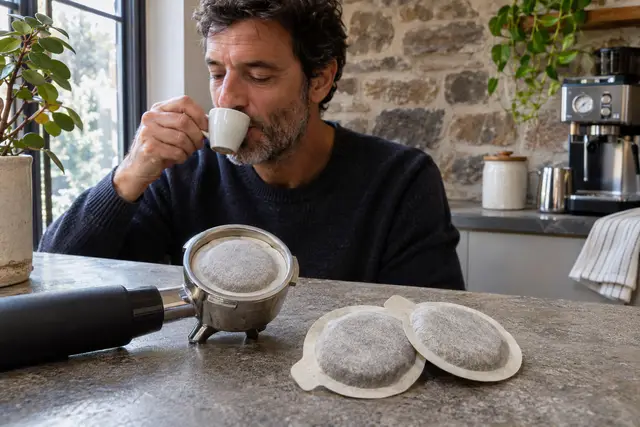
A manual coffee pod machine is an appliance on which the user starts and stops the extraction personally, by operating a switch or a lever, with no memorised volume. It prepares a coffee from an individual pod of ground coffee, through which hot water passes under pressure. The user alone decides how much water runs through, which sets the strength and length of the drink. Its simple principle and limited controls appeal to those who prefer to set every cup themselves.
Taking control of the extraction
On a manual appliance, no sensor decides for you. You press the switch, the coffee starts to flow, you watch, then you cut it off. This freedom lets you adapt the drink to each cup: a very concentrated ristretto in the morning, a longer coffee in the afternoon. It demands attention, but it brings a direct relationship with the drink. Many enthusiasts see it as a way of understanding better what they drink.
The controls in practice
A manual machine has few controls: a main switch, a heating light, a button or lever for extraction. This simplicity reduces electronic faults and makes the appliance easy to repair. The light shows that the water is at the right temperature: wait for it to come on before starting the coffee, otherwise the extraction is done with water that is too lukewarm. A machine with no light calls for a cautious waiting time, given in the instructions.
Learning to judge when to stop
A coffee stops at the right moment when the colour of the stream lightens. At the start, the coffee comes out thick and dark; towards the end, it turns pale and watery. Cutting at that moment avoids bitterness. Also watch the foam that forms on the surface: a fine hazelnut layer is a sign of a successful extraction. After a few attempts, the eye and the ear recognise the right moment.
- Thick, dark start: the beginning of the extraction.
- Golden, steady stream: the middle, the best of the coffee.
- Pale stream: the end, not to be prolonged.
Dosing the water for the cup
The volume of water makes the strength of the coffee. Little water gives a short, dense coffee; more gives a long, light one. To stay consistent, always use the same cup and pick out a constant level, for example an imaginary line inside. A transparent cup helps with checking. You can also time it with a watch: about twenty seconds for an espresso, a little longer for a longer coffee.
The pod as a marker of consistency
The pod guarantees an identical dose of grounds, which simplifies learning: only the volume of water varies. This lets you put a difference in taste down to a single cause, the flow time. Use the same pod several days in a row, with the same setting, then change one parameter at a time. It is the surest method for understanding your appliance.
Preheating by hand
On a manual appliance, it is up to you to preheat. Run a little water into the cup, throw it away, then start the pod. Also warm the pod holder by leaving it in place for a few moments before the extraction. These steps avoid the thermal shock that cools the coffee. They take about fifteen seconds and gain several degrees in the cup.
Pros and cons
Among the advantages are the often moderate price, the reliability of the mechanism and the freedom of adjustment. Among the drawbacks are the need to watch the flow, the risk of uneven results for a distracted user, and the lack of programming. A manual appliance is poorly suited to someone who makes their coffee at the same time as the children's breakfast; it suits well the person who takes their time.
Routine maintenance
Cleaning is generally limited to the pod holder, the tray and the reservoir. Rinse after each coffee, dry the tray, empty the drip tray. Descale according to the instructions, because limescale builds up without the appliance warning you. On an appliance with no alert, note the date of the last descaling on a piece of paper stuck under the tray, or in a diary.
Safety in use
As the extraction is started by the user, do not leave it unattended: an appliance that keeps running overflows the cup and scalds. Do not remove the pod holder before the pressure has gone. Do not leave the appliance switched on in the user's absence, because it has no automatic standby; check that it is off before leaving the house.
Keeping a small notebook of settings
Enthusiasts of manual appliances often note three pieces of information: the pod used, the flow time and their impression of the taste. Within a few weeks, this notebook reveals the settings that suit best. It also helps to spot a drift: if the same coffee, with the same time, suddenly turns bitter, the appliance is probably scaled up. This simple, inexpensive habit turns use into real learning.
Beginners' mistakes
The most frequent is to start the extraction before the water is hot. Next comes forgetting to fill the reservoir, which makes the pump run dry. Another mistake is to prolong the flow to get a large coffee from a single pod, which turns bitter and empty. Finally, many forget to rinse the pod holder, where residual grounds go rancid. These habits are easily corrected, provided you become aware of them.
Choosing the right cup
With a manual appliance, the cup also serves as a measuring glass. An espresso cup, with a rounded bottom, lets you judge the quantity at a glance. A wide mug spreads the coffee out and cools it faster. Prefer a thick porcelain cup, preheated, which retains heat and shows off the foam. Always keep the same cup so as to compare your attempts.
What to do if the coffee runs too fast or too slowly
A coffee that runs too fast often comes from a badly seated pod, a worn seal or insufficient pressure. A coffee that runs too slowly points to an over-packed pod, a blocked filter or limescale. Check the pod and the seal first, then clean the shower screen. If the problem persists, descale the appliance before changing brand of pods.
Sorting and end of life
Used paper pods go in with the food waste if the council allows it. A manual appliance contains fewer electronic components than a programmable model, but it remains electrical equipment to be taken back to a shop or recycling centre when you part with it. A well-maintained appliance lasts many years.
Manual or automatic, which to choose?
The manual suits those who like to set things themselves. The automatic suits those who prefer consistency without effort.
Is the coffee better with a manual appliance?
Not necessarily. It can be in attentive hands, or worse in distracted ones.
Do you have to watch the whole extraction?
Yes, to cut it at the right moment and avoid overflowing the cup.
Training your palate
Tasting each cup attentively develops taste memory. Note whether the coffee is rather sour, bitter, round or flat, and look for the cause in your technique. A sour, pale coffee often comes from too short an extraction; a bitter, dry coffee from one that is too long or water that is too hot. Drinking a glass of water between two attempts neutralises the mouth and makes the comparison more reliable.
With a little practice, a manual appliance offers a pleasure that fully automatic machines do not: that of having made your cup yourself.
To make progress, change one parameter at a time, wait a few days, then compare your notes. This patience is the real secret of a consistent coffee, whatever the machine.
If you share the appliance with another person, agree on the usual volume and keep the reference cup within reach.