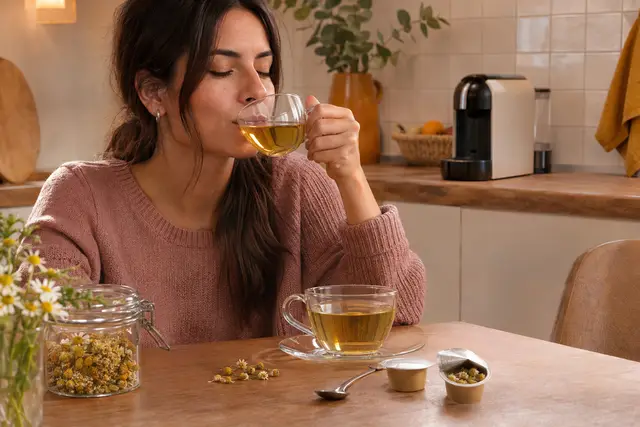
A sleep tea pod is a single portion of dried herbs, such as chamomile, lime blossom, verbena or lemon balm, placed in a paper filter or a capsule. It is prepared with hot water, in a cup or in a compatible machine, and contains neither caffeine nor theine. It accompanies an end-of-day ritual for adults who want a soothing hot drink before going to bed. It remains an ordinary everyday consumer product and is not a medicine of any kind for insomnia or other sleep disorders.
Herbs commonly used
Blends meant for the evening most often combine chamomile, lime blossom, verbena, lemon balm, orange blossom, passionflower or valerian root. These plants have a long tradition of use as infusions, but a tradition is not proof of effectiveness: the effect felt varies from one person to another and does not replace medical advice when problems persist.
The exact composition appears on the packaging. Some recipes are limited to two or three gentle herbs, others combine six or seven. The longer the list, the more carefully one should check for any plant to which one might be allergic or sensitive, notably among the daisy family for people who are allergic to ragweed or chamomile.
A caffeine-free drink designed for the evening
The first appeal of a drink of this kind is that it contains no caffeine or theine, two stimulant substances. It therefore fits into an end-of-day ritual: dimmed lights, screens switched off, a warm cup held in both hands. The ritual sometimes counts as much as the herb, because it signals to the body that it is time to slow down.
A herbal tea does not cure insomnia. If falling asleep stays difficult for several weeks, if tiredness interferes with the day, or if heavy snoring and pauses in breathing are noticed, a medical consultation is the right step.
Taste and mouthfeel
Chamomile offers a floral, slightly honeyed note, lime blossom a soft, round fragrance, verbena a lemony freshness, and lemon balm an aroma close to lemon and mint. Valerian is recognised by a strong smell, sometimes judged unpleasant; manufacturers often mask it with liquorice or orange. Blends with a very pronounced taste suit sensitive palates less well.
Formats and machine compatibility
The soft paper pod, 60 to 70 mm in diameter, is used in soft-pod machines, whereas the rigid capsule requires the exact system it was designed for. Because dried herbs are light, the volume of water set on the machine has a large effect on the result: a setting that is too short gives a weak drink, and one that is too long dilutes the fragrance.
Switching from a coffee machine to a machine used for infusions calls for a careful rinse. Coffee residues leave an aftertaste that contradicts the very idea of a stimulant-free evening drink.
Preparation step by step
- Heat the water without letting it boil for too long.
- Place the pod in the cup or in the machine, depending on the type of equipment.
- Pour in the water and leave to infuse for about five to ten minutes for a manual preparation, covering the cup to retain the aromatic oils.
- Remove the pod and taste before adding a little honey, if you like.
Covering the cup during infusion is a simple gesture that preserves the volatile compounds of the flowers. It is advisable to drink the herbal tea warm rather than scalding, and not to have it too close to bedtime if you often wake in the night to go to the toilet.
How much per day?
The product label gives the usual dosage, generally one or two cups in the evening. There is no reason to exceed the stated amount, especially with plants such as valerian or passionflower, whose prolonged use calls for professional advice.
Precautions and contraindications
Herbs are not harmless. Pregnancy, breastfeeding, taking sleeping pills, anti-anxiety drugs or other medicines, as well as liver disease, mean that one should ask a doctor or pharmacist before regularly consuming some of them. Valerian and passionflower, for example, are known for their sedative effects and can add to those of a medicine.
A drink of this type is also not recommended before driving or using dangerous machinery if you feel drowsy. It is not intended for young children without the advice of a healthcare professional, and the leaflet should always be read carefully.
Evening ritual and healthy habits
A hot drink belongs within a set of good habits: regular bedtimes, a ventilated and cool bedroom, a light evening meal, and physical activity during the day rather than late in the evening. The pod makes the ritual easier because it removes the measuring and the cleaning of a teapot, which makes the gesture achievable even when tiredness is setting in.
Cutting down on coffee, black tea and energy drinks after the start of the afternoon usefully completes this approach. A herbal tea does not make up for an over-stimulated day, but it can mark a pleasant transition.
Price and storage
The price per cup depends on the quality of the herbs and any organic origin. An organic label guarantees a method of cultivation, not effectiveness. Dried herbs keep best away from light, heat and damp; a well-closed box preserves the aromas better than an opened packet left in a spice cupboard.
A pod that has lost its fragrance or whose paper is damp should be thrown away. The best-before date shown on the box serves as a guide, beyond which the aroma weakens markedly.
Sorting, recycling and alternatives
Compostable paper pods go to the compost or food waste when the packaging says so, while plastic or aluminium capsules follow local sorting instructions. The cardboard box goes in with paper and cardboard, whereas any plastic film depends on the rules of the municipality.
Alternatives include the classic infusion bag, loose herbs with a reusable infuser, or a simple cup of hot lemon water for those who prefer to avoid herbs. Loose herbs offer a wider choice of plants and reduce packaging, but they require weighing out the quantities and rinsing the utensil.
Choosing according to your profile
A person sensitive to strong smells will prefer a blend of chamomile and orange blossom, which is more delicate than a valerian preparation. Someone who enjoys fresh flavours will turn to verbena and lemon balm. Lovers of sweet notes will choose lime blossom or liquorice, while bearing in mind that liquorice does not suit everyone, in particular people prone to high blood pressure.
Buying a small box first makes it possible to test the taste before committing to a large size. An assortment of several herbs also helps to identify the one you tolerate and truly enjoy.
Frequently asked questions
Can the drink be taken cold?
Yes, a cooled infusion can be drunk without difficulty, but the ritual of the hot drink then loses some of its charm. It should be consumed within the day and kept in the refrigerator.
Can the preparation be sweetened?
A small teaspoon of honey is common among adults. Honey is, however, forbidden for children under one year old, because of the risk of infant botulism.
What is the difference from an ordinary infusion?
The term herbal tea in practice means a drink made of plants without any tea plant, just as an infusion does. The nuance lies mainly in the use: this one is designed for the evening and favours gentle herbs without stimulants.
If the problems persist despite good habits, it is better to consult a doctor than to increase the number of cups or multiply the blends.