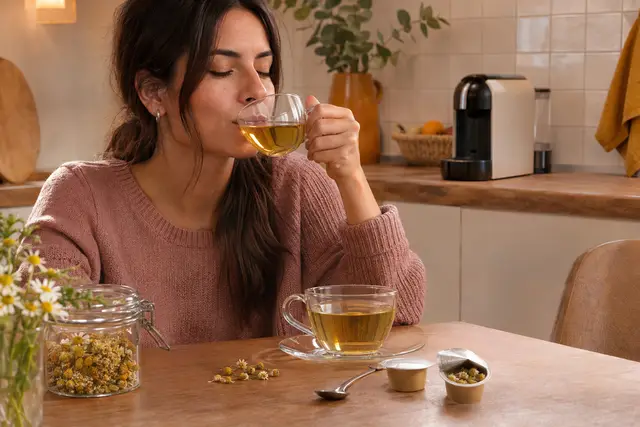
A linden tea pod is an individual portion of dried linden flowers and bracts, from a large tree common along avenues and in gardens, placed in a paper filter or a small capsule. The resulting infusion is pale yellow, with a scent of honey and flowers, and contains no theine or caffeine. The portion saves you from gathering and drying the blossoms yourself. It suits those who enjoy soft hot drinks, especially in the evening, and those who avoid stimulants. It is a drink of tradition, not a treatment.
The tree and its flowers
The linden, genus Tilia, is a large tree, planted for centuries along roads, in school yards and on village squares. Two species provide most of the flowers for infusion: the small-leaved lime, Tilia cordata, and the large-leaved lime, Tilia platyphyllos. Each cluster of flowers is attached to a long, narrow, pale leaf called a bract, which is harvested together with the flowers. It is this combination that gives the infusion its scent and its characteristic texture.
Harvest and drying
Flowering takes place in early summer, for two to three weeks. The flowers are picked just after they open, then dried in the shade in an airy place, at a moderate temperature, to preserve their essential oils. Drying that is too hot or too damp turns them brown and makes them lose their scent. In the portion, the bracts and flowers are broken into pieces; a good portion keeps shades from light yellow to pale green.
How to infuse it
Pour water at 90 to 95 °C over the portion, cover the cup and leave to brew for five to ten minutes. The infusion is more fragrant with the cup covered. It does not become excessively bitter, even if left longer, but the taste takes on vegetal notes.
- Cover the cup to keep the aromas.
- Do not go beyond ten minutes, to keep the softness.
- Remove the portion before drinking.
Taste and pairings
The drink has a scent of honey, white flowers and a little hay, with a slightly velvety texture due to natural mucilage. A little linden or acacia honey extends it, and a slice of lemon freshens it. It goes well with dry cakes, madeleines, little butter biscuits and fruit compotes. Served lukewarm, it suits the end of dinner.
Precautions
Linden contains no caffeine. No guaranteed therapeutic effect should, however, be attributed to it: the traditional use of the flower for relaxing is not proof of efficacy. Pregnant or breastfeeding women, young children and people on treatment, in particular for the heart or blood pressure, can ask a doctor or pharmacist for advice before drinking it regularly. In case of pollen allergy, caution is advised. Avoid also drinking large amounts too often over a long period without professional advice.
Compatibility with machines
A pod appliance accepts a single type of portion, according to its manufacturer: 44 mm paper or small-format capsule. Linden bracts, light and flat, take up a large volume; the portion must therefore be designed with a dose and a filter that allow the water to pass without stagnating. Rinse the circuit after the drink so as not to leave the scent of flower honey in the water of a following coffee.
Storage
Dried flowers are kept away from light, humidity and smells. A closed sachet, stored in a dry cupboard, keeps its scent for several months. An old linden smells of dust, and the infusion is then bland. The best-before date on the box gives a guide. In case of mould, a musty smell or small insects, the portion is thrown away.
Picking your own linden
Some enthusiasts pick the flowers themselves: choose a tree away from busy roads and from treatments, harvest in dry weather at the beginning of flowering, and dry the clusters flat on a cloth, in the shade. This harvest requires correctly identifying the tree and respecting local rules on picking. The factory portion avoids these steps and guarantees even drying.
The linden in tradition
In France the linden is an emblematic tree: one was planted in the middle of the village to hold assemblies there, and its foliage gives cool shade in summer. The dried flower is found in many family cupboards, often next to verbena and chamomile. It is traditionally offered to visitors late in the evening. This cultural habit makes it a drink associated with home and childhood, much more than with any health approach.
Linden flowers and honey
Bees forage heavily on lindens, which gives a light honey with a fresh, slightly minty scent. This honey pairs naturally with the infusion, but it does not replace the flower. For those who avoid sugar, the infusion is drunk alone: its honeyed scent already gives an impression of sweetness. Served iced with lemon, it makes a light, low-calorie summer drink.
Choosing your portion well
The statement ‘linden flowers’ or ‘wild linden’ accompanied by the Latin name is preferable to a simple ‘linden flavouring’, which contains no plant. A quality portion contains pale yellow and soft green fragments, with a marked sweet smell. Avoid products that smell musty, brownish fragments or an abundance of dust. An organic label or one for controlled harvesting is a plus, especially for a plant consumed whole.
Frequent mistakes
The first mistake is to pour boiling water on the portion without covering the cup: the light oils evaporate. The second is to leave it to brew for an hour: the taste becomes raw and very vegetal. The third is to mix several plants without knowing their effects. Finally, avoid storing linden in a clear jar exposed to light, which fades it.
Sorting and alternatives
The paper filter and the spent blossoms can be composted when the packaging says so, and otherwise go in the household bin. An aluminium capsule is emptied of its contents before joining the metal collection. To limit packaging, loose linden flowers are prepared in a teapot with a filter, with about a spoonful per cup.
Is linden really caffeine-free?
Yes, the linden flower contains none. A blend with tea would contain some, hence the value of reading the list of ingredients.
What is the difference between flowers and bracts?
The flowers carry the scent; the bracts accompany them in the cluster and add softness and texture to the infusion.
Can linden be drunk every evening?
For most healthy adults, an occasional cup poses no problem. Daily, prolonged consumption calls for a pharmacist’s advice, especially in case of treatment or pregnancy.
Why is linden sometimes slightly slimy?
The bracts and flowers contain mucilage, plant substances that give the drink a supple texture. It is not a fault.
Can the portion be used twice?
The second infusion is clearly weaker. It is better to prepare a new cup with a fresh portion to recover a clear scent.
Which cup should be chosen?
A thick porcelain cup keeps the heat and suits an infusion drunk slowly, in small sips, without hurrying, to enjoy the scent of the flower.