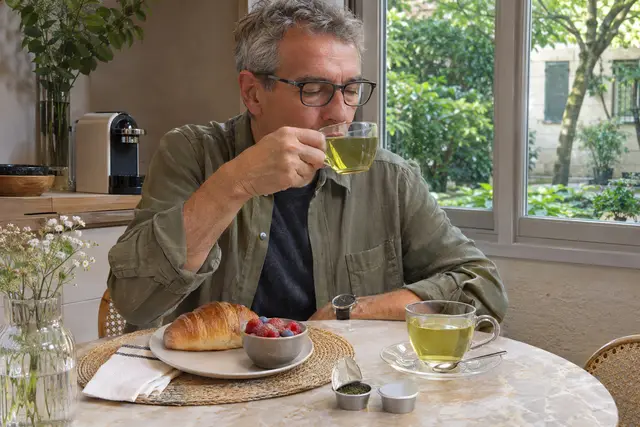
A tea pod machine is an appliance that prepares a cup of tea or herbal infusion from an individual filter-paper pod containing measured tea or herbal leaves. Hot water passes through or soaks the pod placed in a pod holder, then the tea runs into the cup. This paper pod has no rigid shell and no airtight capsule. It appeals to those who appreciate simplicity, grounds that are easy to throw away and lighter packaging, in a household, an office or a guest room.
A paper pod, not a capsule
The difference from the capsule lies in the material. The pod is a small pouch of filter paper, sealed at the edges, that holds the tea leaves. It is not pierced, it is simply passed through or soaked by the water. It looks like a tea bag, but is used in a machine that controls the water and the duration. Less rigid than the capsule, it stores flat and is thrown away with no effort.
How the appliance prepares the tea
The pod holder keeps the pod flat above the cup. Water heated in the reservoir is spread over its surface by a shower head or a spout, then passes through the leaves and runs out. Some appliances let the pod soak briefly before starting the flow. Others work at low pressure, like soft-pod appliances for coffee, which suits tea well.
Setting the temperature
The temperature determines the character of the tea. A green tea prefers water at around 70 to 80 degrees Celsius, a black tea hotter water, a herbal infusion almost boiling water. If the appliance offers no setting, let the water rest for a moment after heating for delicate teas, or run the circuit with no pod to bring it down slightly. Water that is too hot burns the leaves and releases bitterness.
Choosing your pods
Tea pods exist in black, green, white, flavoured teas and in infusions. Check the compatibility note for your appliance: diameter, shape and type of paper. A pod that is too wide folds in the pod holder and lets water pass at the edges. Prefer those whose packaging states the composition, the origin of the leaves and the best-before date. Store them away from damp, light and strong smells.
- Flat pod: good contact with the water, even infusion.
- Domed pod: more leaves, a stronger taste.
- Herbal pod: very hot water advised.
Infusion time
A pod that does not soak enough gives a pale tea. If your appliance allows a pause, let it infuse for one to three minutes depending on the type of tea: shorter for a green tea, longer for a black tea. Failing that, start the flow a second time on the same pod, but with no more than one repeat. Beyond that, the tea turns bitter and cloudy.
Simple maintenance
Paper pods leave few residues, which makes upkeep easier. Remove the pod after use, rinse the pod holder and wipe the tray. The aromas persist in the plastic parts; wash them regularly with a little washing-up liquid, rinsed thoroughly. Descale the appliance at the frequency given in the instructions. Avoid leaving the damp pod in the appliance, which develops mould and odours.
Water quality
Water counts as much as the leaves. Very chalky water gives a dull tea and leaves deposits on the heating element. Soft, low-mineral water respects the aromas. If your tap water is hard, a filter jug placed beside the appliance improves the taste and protects the circuit. Change the water in the reservoir every day and do not let it stand.
Economy and budget
The paper pod generally costs less than a capsule, while remaining dearer than a tea bag or loose tea. The appliance, often simple, remains affordable. Work out the cost of a cup by counting the pod, water, electricity and depreciation. A heavy tea drinker would do well to compare with a kettle with adjustable temperature, a teapot and leaf tea.
Leaves and composting
The used pod is a small pouch of damp leaves. If the paper is entirely plant-based, with no plastic or synthetic glue, it can go to the compost bin or food waste, depending on the council's rules. Check the packaging: a pod sealed by a plastic weld cannot be composted. Empty the leaves into the compost, and put the non-compostable paper in the household rubbish.
Morning tea, evening tea
The same appliance can accompany the whole day. In the morning, a strong black tea, rich in theine, helps you get going. In the afternoon, a lighter green or white tea is gladly drunk. In the evening, a caffeine-free infusion, such as camomile or verbena, is better suited to rest. Store the pods by time of day in separate boxes, so that you can choose without hesitation.
Serving several people
For a group, prepare the cups in advance and start the pods one after another. Allow one to two minutes per cup, infusion included. Provide a plate for putting down used pods, to avoid soiling the worktop. If guests like strong tea, offer two pods in a large teapot for quicker sharing.
Solving small problems
A tea that is too weak points to insufficient temperature, too short an infusion or a pod that is too old. A tea that is too bitter points to water that is too hot or a prolonged infusion. A tea that smells of coffee reveals a badly rinsed circuit. A slow flow signals limescale. Each case is settled by a simple step: rinse, descale, change pod or water.
Keeping your pods in good condition
Paper absorbs damp and odours. Keep the pods in their original packaging, then in a closed box, in a dry place. Do not store tea near spices, coffee or cleaning products. A pod that has gone soft or stained should be discarded: it risks tearing in the pod holder and spreading the leaves through the circuit.
Safety in use
The water and the pod holder are very hot. Do not touch them before the flow has ended and keep the appliance out of the reach of children. Serve lukewarm drinks to young children and older people. For herbal infusions, read the leaflet: some plants are not recommended during pregnancy or with a course of treatment. Ask a doctor or a pharmacist for advice if in doubt.
Where to use it
This appliance finds its place in households that like tea, in offices where a few people drink varied teas and in guest rooms that offer visitors a choice. Its ease of use suits guests, who have nothing to set. The pod keeps flavours well apart: you just need to rinse the spout between two very different teas.
Can you use a coffee pod?
No, mixing uses should be avoided, because coffee leaves oils and a lingering taste in the circuit.
Does pod tea taste the same as from a teapot?
It comes close if the temperature is right, but the leaves are cut finer, which gives a more direct taste.
Can the pod be reused?
A second infusion is possible for some teas, but the taste is clearly lighter.
Tips for a successful tea
Preheat the cup, use fresh water and do not let the pod soak longer than necessary. Add sugar or milk after the infusion. Taste before adjusting. A good-quality tea is often enough on its own, with nothing added.