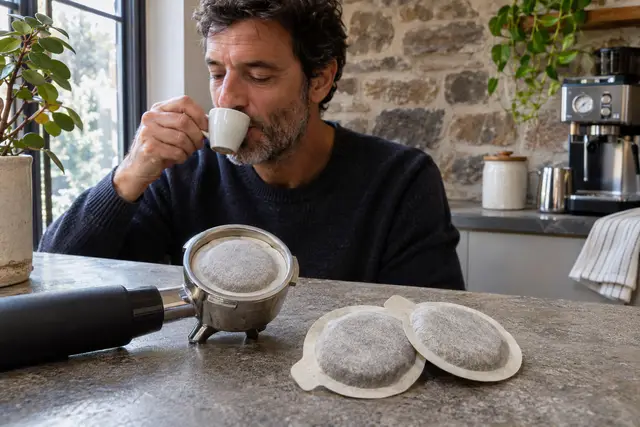
A hard coffee pod is a disc of compressed filter paper, 44 mm in diameter, containing about seven grams of ground coffee and sealed on all sides. It is also known by the abbreviation E.S.E., for Easy Serving Espresso, a standard shared by many roasters. Placed in a portafilter with a seal, it receives hot water under the pressure of an espresso machine. It suits people who want a strong coffee with crema, without grinding or tamping, while keeping the freedom to change supplier thanks to a common format.
A format born of an agreement between manufacturers
Unlike most capsules, the rigid pod does not depend on a single manufacturer. It rests on a standard, published at the end of the 1990s, which fixes the diameter, the dose and the type of paper. Several roasters and machine makers rallied to it, so that the consumer can freely pair a machine with pods from various sources.
It is sometimes written that this format is partly metallic or that it dates back to the 1970s. That information is inaccurate. The pod is made entirely of paper, enclosed in an individual wrapper that protects it from air, and it was standardised much later. The term "hard" merely describes its relative rigidity, compared with the soft cushion.
What makes it rigid
The coffee is compressed into a puck between two discs of filter paper sealed around the edge. This compression, carried out at the factory, replaces the tamping done by hand with a conventional portafilter. It guarantees an even density, and therefore a constant flow of water from one cup to the next.
How it works in the machine
The pod slides into a portafilter fitted with a suitable basket, often supplied with a second basket for ground coffee. You flatten it slightly, lock the portafilter under the group head, then the pump sends the hot water. The pressure used is that of an espresso, around nine bars at the outlet of the group head, far higher than that of soft-pod machines.
This pressure extracts the oils and forms a fine crema on the surface. The filter paper holds back the particles, and the cup stays clear. The coffee flows in about twenty seconds for an espresso, and you stop the flow at the volume you want.
- Choose a basket designed for the pod, flatter than a ground-coffee basket.
- Centre the pod before locking, with no folds around the edge.
- Preheat the machine and the cup to keep the coffee hot.
Compatibility: an open standard, varied machines
Any machine whose portafilter accepts 44 mm pods can use portions of different brands. Appliances sold for ground coffee but supplied with a specific basket for pods are included. Small office machines dedicated to pods alone have a fixed housing and a simpler lever.
Before buying a box, check for the "E.S.E." or "44 mm" mention on the packaging, and make sure the portafilter takes it into account. A pod that is too small lets water pass around it, one that is too large prevents the portafilter from locking.
Taste, crema and intensity
The coffee from a rigid pod comes close to that of a bar espresso. The body is rounder, the bitterness more marked and the crema thicker than with a soft pod. The grind, chosen by the roaster for the pressure of the machine, cannot be adjusted, but manufacturers offer several intensities, roasts and origins.
Freshness matters a great deal. Aged coffee gives little crema and a flat taste. Check the best-before date and buy boxes you can use up within a few weeks. A pod whose wrapper is pierced or swollen is discarded.
Rigid format or ground coffee?
Ground coffee offers control over dose, grind and tamping, but requires practice. The hard pod removes those steps and gives a more regular result for a beginner. In return, it costs more per cup, because you pay for the paper, the conditioning and the distribution.
Knowledgeable enthusiasts often keep both possibilities: a pod for rushed mornings, ground coffee for the weekend, with a grinder for the days when they want to adjust. This mixed use calls for a machine with a double portafilter and a little storage space.
Price and budget
The price of an E.S.E. pod varies with the origin of the coffee and the size of the pack. Pods from independent roasters generally cost more than those from large retailers, but their coffee can be more carefully made. As always, divide the price of the box by the number of portions to compare, and add the depreciation of the machine.
The advantage of the open standard is competition: a maker who raises its prices too much can be left without changing machine. That advantage does not exist with closed capsule systems.
Waste, composting and sorting
The used pod consists of paper and coffee grounds. It goes into the home compost or the organic waste collection if the local authority provides one. The individual wrapper, for its part, is generally a metallised or plastic film that must be thrown away with ordinary waste or sorted according to local rules.
Some manufacturers offer a paper or cellulose wrapper, easier to recover. You can spot it by reading the packaging, which states the materials and the sorting actions.
Maintenance tips
The portafilter, basket and group head are rinsed after each cup. Once a week, wash the basket in hot water and wipe the seal, to avoid deposits of oil that turn rancid. Periodic descaling, according to the instructions, protects the boiler and the pump.
The seal of the group head wears over time. When the pod leaks at the side or locking becomes stiff, replace the seal, an inexpensive part. This simple upkeep extends the life of an appliance for many years.
Is the coffee too bitter or too pale?
A bitter coffee often comes from a machine that is too hot or a pod that is too old. A pale coffee signals a leaking seal, an unsuitable basket or a badly centred pod. Try another box before blaming the machine, then check the seals and the basket.
Making a good espresso, step by step
Begin by heating the machine until the light shows the right temperature, then run a little water through to rinse the group head. Place the pod in the centre of the basket, the more domed side facing up, and lock without forcing. The preheated cup is set under the outlet. As soon as the pump starts, the first dark trickle flows, then the crema forms.
An espresso is drunk short, at around thirty millilitres. Stop the flow when the colour of the coffee lightens, because the end of the extraction brings mostly bitterness and astringency. For a longer coffee, add hot water to the cup after extraction rather than prolonging the passage through the pod.
Can the same pod be used twice?
No. A second extraction gives a watery, bitter drink with no taste value. The pod is designed for a single infusion at espresso pressure, and the wet grounds hold residues that deteriorate quickly. Remove it as soon as the cup is served.
What about milk?
The rigid pod goes well with milk, because the espresso keeps its presence against hot milk. A machine with a steam wand lets you prepare a cappuccino, provided you purge the wand before and after each use to avoid milk deposits.