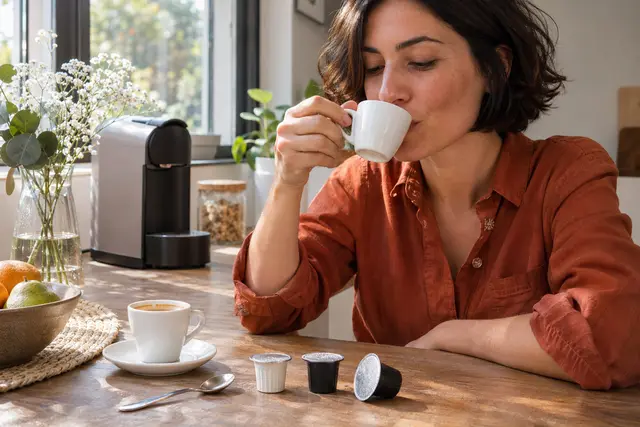
A single-serve portion capsule in plastic is a cup moulded from thermoplastic material, closed with a lid, that holds a portion of ground coffee or another drink. The plastic is most often polypropylene, sometimes combined with a thin barrier layer against oxygen. It is pierced or opened by the machine, which passes hot water through it under pressure. Light, inexpensive and easy to mould into varied shapes, it is aimed at users of capsule machines who want a quick drink, with no grind to adjust and no filter to clean.
The plastics used for the cup
The most common material is polypropylene, a heat-resistant plastic that is light and easy to mould by injection or thermoforming. It withstands the passage of hot water without deforming and transmits no taste to the coffee. Some capsules use polyethylene, polystyrene or blends, depending on the performance sought.
These plastics are described as food grade: they comply with the European rules on materials in contact with foodstuffs. The manufacturer must be able to prove, through a declaration of conformity, that the substances migrating into the drink stay below the permitted limits.
The oxygen barrier layer
Plastic lets small amounts of oxygen through, which would eventually spoil the ground coffee. To remedy this, many capsules are multilayer: a thin layer of a barrier polymer, such as ethylene vinyl alcohol, is inserted between two layers of polypropylene. This structure slows the passage of air, without reaching the total tightness of metal.
The price to pay is harder recycling. Several materials welded together do not separate easily in conventional facilities. Single-material capsules, with no barrier layer, offer better recyclability, but a shorter shelf life.
How it works in the machine
The cup is placed in a housing, then the machine pierces the upper lid and sometimes the base. Hot water passes through the coffee, then the drink flows into the cup through a small hole. Some formats are designed for low-pressure machines, others for pump appliances.
Plastic allows sophisticated shapes: built-in filters, diffusion channels, nozzles to regulate the flow. These details influence the quality of the extraction and the formation of the froth. They also explain why capsules are not interchangeable from one system to another.
Advantages of plastic
Plastic is light, inexpensive and easy to make in large production runs. A plastic capsule weighs little and is carried at lower cost, which limits the footprint of transport. It withstands knocks, which avoids deformed capsules in the parcel.
Its transparency or coloured tint also makes it possible to vary the packaging and the ranges. Finally, plastic has the advantage of not altering the taste of the drink, when the material is well chosen and the moulding careful.
Drawbacks and criticisms
The main reproach concerns waste. A capsule is a small, single-use package, soiled with grounds. Multiplied by several cups a day and by many households, the volume becomes large. Small plastics are also among the hardest to recycle.
Another point concerns heat: some consumers fear a migration of substances from the plastic into the hot coffee. Compliant capsules are checked, but avoid reusing a damaged cup or heating it in the microwave. If in doubt, ask the manufacturer.
Recycling: what you need to know
In France, the extension of the sorting rules allows all plastic packaging to be put in the sorting bin, including small items, but the result depends on the local sorting centre. Very small capsules sometimes fall into the sorting rejects and end up being incinerated.
Several manufacturers organise specific collections, with drop-off points or return bags. Check these schemes on the packaging. Emptying the grounds before throwing the capsule away improves the quality of sorting, even if the gesture takes time.
Separating the grounds and the packaging
Coffee grounds are an organic waste that is valuable for compost. They are recovered by opening the lid with a small tool or a knife, then emptying the contents into the compost bin. The emptied cup joins the sorting stream or the collection point.
This separation is the most useful gesture a consumer can make. It gives the coffee a second life and allows the packaging to be treated properly. It is, however, tedious for anyone who drinks several cups a day.
Safety in use
Capsules are used only in the machines designed for them. A plastic cup does not go in an oven, a microwave or a conventional coffee maker. A melted or deformed capsule is to be thrown away, as is one whose lid is swollen.
Keep the packaging out of the reach of young children, who might swallow small pieces. Hot machines call for the same precaution: a child can be scalded by the water or the steam.
Alternatives to consider
To reduce plastic waste, several options exist: the aluminium capsule, better recycled, the compostable paper pod, the refillable stainless steel capsule, or simply ground coffee and a cafetière. Each option shifts the compromise between comfort, cost and impact on the environment.
An attentive consumer compares the material, the possibility of take-back, the amount of coffee per capsule and the price per cup. There is no perfect solution, only trade-offs to be made with full knowledge.
Plastic capsules for things other than coffee
The format is not limited to coffee. You find plastic capsules filled with tea, hot chocolate, milk powder, soups or flavoured drinks. Each recipe needs a suitable cup: a milky drink calls for more careful cleaning of the circuit, an infusion of leaves needs a more open filter.
These variants show the flexibility of plastic, which lends itself to very different cup shapes. They also raise the question of mixing drinks in the same machine: a rinse with no capsule between two preparations stops the aromas passing from one capsule to the next.
Storage and keeping
Plastic capsules are kept away from light and heat, in their original box. Their shelf life is generally shorter than that of metal capsules, because of a less effective oxygen barrier. The date shown on the packaging applies to an unopened box.
Once opened, the box is closed carefully. Capsules loose in a kitchen drawer, near a hob, age faster. A closed container keeps out dust and the smells of the room, which plastic can pick up slightly.
Maintaining the machine
A plastic capsule machine is maintained like the others: empty the used capsule tray and the drip tray regularly, clean the housing with lukewarm water, and descale the circuit according to the hardness of the water. A dirty appliance passes an unpleasant taste to the coffee, whatever capsule is used.
Piercing the plastic sometimes produces small fragments, caught by the internal filters. A rinse with no capsule once a day, and a deeper clean each week, ensure steady operation. The appliance's instructions specify the compatible products.
One last piece of advice: keeping the proof of purchase and the exact reference of the system makes it possible to claim in the event of a faulty batch, for example when several cups are cracked or badly sealed on opening the box.