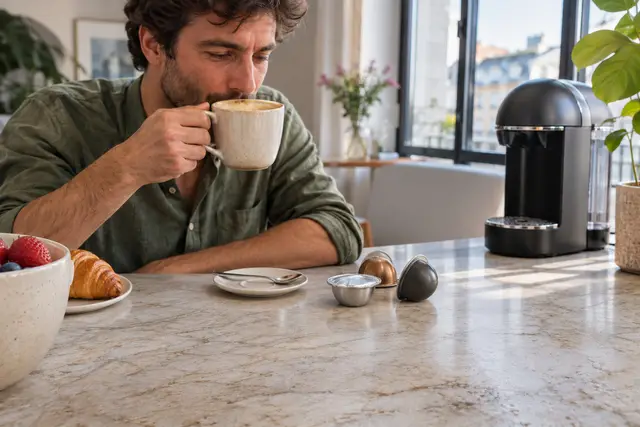
An automatic coffee pod machine is an appliance that takes care of the preparation steps by itself: heating the water, extracting through an individual pod of ground coffee, stopping at the programmed volume and going into standby. The user places the pod, closes the pod holder and presses a button, without watching the flow or stopping the coffee by hand. It brings consistency and comfort to people in a hurry, to families and to small teams who drink several coffees a day.
One button, one coffee
The word “automatic” covers a set of functions that lighten the task. On a manual appliance, the user decides when the water starts and when it stops. Here, the appliance measures the quantity of water delivered itself and cuts the pump at the right moment. The coffee therefore comes out the same way, morning after morning, whatever the attention of the person making it. This consistency matters to those who make their coffee while thinking of something else.
The programmed volume
The most popular function is the memorising of the volume. It works with a flow counter or a flow time. You set the quantity once, generally through a procedure described in the instructions, then the appliance reproduces it. Some models offer two or three memories: espresso, short coffee, long coffee. If the cup changes, you simply reprogram. A badly adjusted programme gives a coffee that is too dilute or too concentrated; test several values before fixing the setting.
Shut-off and standby
An automatic appliance goes into standby after an adjustable delay, often a few minutes. It saves energy and reduces risks in case of forgetfulness. Some switch off completely after a longer period. On waking, you sometimes have to wait a few tens of seconds for the water to come back up to temperature. Check that the standby can be adjusted or switched off, to suit your rhythm.
Rinsing and purging
Several models start a rinse at switch-on or switch-off, which flushes coffee residues out of the circuit. This step uses a little water but avoids off-flavours and clogging of the ducts. If the drip tray fills quickly, it is often a sign of an automatic rinse: empty it regularly. A manual purge remains useful after descaling or a long period of disuse.
Maintenance alerts
Recent appliances signal by a light or a screen that they need descaling, the reservoir filling or the tray emptying. These alerts are valuable, but they do not replace common sense: if the flow drops or the taste changes, do not delay, whatever the indication. Some counters are based on the number of coffees served rather than on the real hardness of the water, and can therefore be wrong. In a very hard-water region, descale a little earlier than the alert.
What automatic does not do
It does not choose the pod for you, does not adjust the hardness of the water and does not replace cleaning. Nor does it make up for an out-of-date or badly centred pod. An automatic machine is an assistant, not a cook. It is up to the user to place the pod correctly, change the water and clean the pod holder.
Which pods
Most pressurised automatic appliances use the 44 mm E.S.E. pod. Check this wording before buying, as well as any compatibility with the soft pod. An automatic appliance set for a dense pod gives a mediocre result with a pod that crumbles. Choose well-made, firmly packed pods, and store them dry.
Noise and comfort of use
The pump works by vibration and makes noise during extraction. An automatic appliance is often quieter at rest thanks to the complete stop of the heating. Place it on a non-slip mat to limit resonance. Comfort also lies in the simplicity of the controls: a small number of buttons, clear pictograms, a light that can be read from a distance.
Energy
Automation makes it possible to save energy if the standby is well set. An appliance that heats constantly uses more. If you drink little coffee, choose a short standby. If you drink it all day, a longer standby avoids waiting for reheating. Unplugging the appliance at night or while away remains the most economical step.
Automatic safety
Recent models include protections: shut-off in case of overheating, no water, or a badly closed pod holder. These safety features do not replace caution: a scalding pod holder remains dangerous, and a child must not handle the appliance alone. Regularly check the condition of the cable and the plug, and stop using an appliance whose casing is cracked.
Waste and end of life
Used paper pods are sorted according to the council's rules. They go to the compost or food waste when the wrapper is made entirely of paper. The appliance is taken to a shop or recycling centre. The more electronics it contains, the more important it is to have it recycled properly, because the components can be recovered.
Is automatic more expensive?
Often a little more than a manual model, because it contains additional electronic components. The comfort justifies this extra cost for daily use.
Can you stop the flow before the end?
Yes, on most models, by pressing the button again. Check the instructions for the exact behaviour.
What should you do if the volume drifts?
Reprogram it, descale the appliance and check the pod. Scaling changes the flow and distorts the measured volume.
Choosing your model well
Compare the number of volume memories, the quality of the alerts, the ease of access to the reservoir and the tray, the stated noise level and the length of the guarantee. Try the appliance if possible: the feel of the buttons, the clarity of the light and the ease of cleaning make the difference day to day. A well-designed appliance fades into the background; a badly designed one becomes a source of irritation.
Changing your habits
With an appliance that does everything by itself, some users drink more coffee without realising it. One cup after another, caffeine intake rises. Keep an eye on it, especially late in the day, and offer yourself a decaffeinated coffee or an infusion made from suitable pods. Convenience should not make you forget moderation.
Setting the extraction temperature
Some automatic appliances offer two or three temperature levels. Hotter water brings out bitterness and body; slightly cooler water preserves acidity and fruity aromas. For a coffee made from a classic blend pod, the middle setting most often suits. Change level with care and taste each result, because the effect depends on the coffee.
Use within the family
An automatic machine is easy to entrust to a teenager or a guest. A few written instructions are enough: one pod, close the lever, one button. Warn about the scalding parts and remind them that coffee is not recommended for young children. Choose a spot out of their reach, with a firmly secured cable.
Lifespan of the components
The pump, the seals and the heating element are the parts under strain. Regular descaling, filtered water and the use of well-centred pods extend their life. If the appliance shows signs of weakness, such as an unusual noise, a weak flow or insufficient temperature, do not force it: have it checked before a small fault becomes an expensive repair.
Comparing with a manual model
The manual leaves control to the user and often costs less; the automatic brings consistency and peace of mind. If you like to adjust every parameter, the manual will suit you better. If you prefer simplicity, the automatic is more suitable. Neither is better in absolute terms: it all depends on your habits and your taste for the gesture.