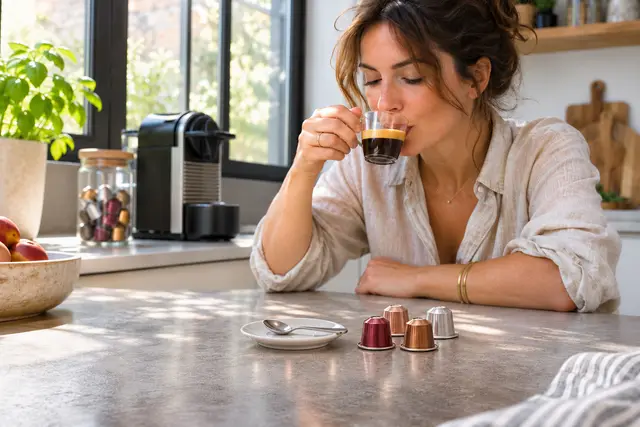
A coffee pod machine for pods and ground coffee is a pump-driven espresso appliance whose portafilter is filled either with a forty-four-millimetre paper pod or with ground coffee poured into a basket. It combines the convenience of the pod, with no dosing or tamping, and the freedom of ground coffee, chosen for its origin and freshness. It suits households that want a quick, reliable espresso on busy weekdays and a more personal coffee at the weekend, without having to buy two different machines.
Two baskets in one portafilter
To move from one use to the other, you change the basket. The pod basket is flat and shallow, with a wall that holds the paper round in place. The ground-coffee basket is deeper, pierced with small holes, and takes grounds measured by hand. Some portafilters come with both baskets, others with a single piece that does both jobs, taking the pod on a removable insert.
The basket is chosen before filling the portafilter: putting a pod in a deep basket leaves it floating, and pouring ground coffee into a flat basket makes it overflow.
Using a pod
The routine is the simplest: lay the pod flat, lock the handle, start the extraction. The dose and the compression are already done. You only need to pre-heat the portafilter and stop the flow after twenty-five to thirty seconds, for a drink of about thirty millilitres.
This mode suits rushed days, guests who want a coffee without ceremony and users who dislike handling powder.
Using ground coffee
- Weigh about seven grams of finely ground coffee for a single espresso.
- Pour it into the basket and spread it flat with a light movement.
- Tamp with a tamper, using an even, level pressure.
- Wipe the rim of the basket, lock the handle and start the extraction.
The dosing and the tamping make all the difference. Coffee that is tamped too little gives a watery espresso, and coffee tamped too hard makes the pump struggle.
Pressurised or classic basket
Some machines offer a so-called pressurised basket, fitted with a small valve at the outlet. It tolerates a less precise grind and makes an artificial froth even with stale coffee. A classic basket, more demanding, gives a finer result with a suitable grind and careful tamping.
For a beginner, the pressurised basket is more forgiving. With experience, you move to the classic basket to control the extraction better.
Choosing the ground coffee
Pick a coffee marked for espresso, freshly roasted and ground as recently as possible. An opened packet quickly loses its volatile aromas. A small burr grinder, plugged in nearby, lets you grind to the dose and reach the fineness you want. The grind is right when the extraction lasts between twenty-five and thirty seconds.
Taste compared
Pods ensure consistency: Monday's cup is like Friday's. Ground coffee offers more relief, with clearer aromas when the bean is fresh, but demands discipline. Switching between the two lets you identify your preferences: strength, acidity, length in the mouth.
Cleaning for both modes
After a pod, the basket stays almost clean: a rinse is enough. After ground coffee, the grounds cling to the walls and the grid. Knock the basket out over a compost bin, rinse in hot water and rub the grid with a soft brush. Once a week, a cleaner made for coffee machines removes the oils.
The shower screen under the brewing head gets dirty faster with ground coffee: wipe it regularly.
Machine settings
The pump pressure cannot always be adjusted, but the volume and the temperature can be on some models. A slightly lower temperature softens a very dark roast; a higher one helps a light coffee express itself. Note your trials so you can find the perfect cup again.
Budget
A pod costs more per gram than ground coffee, but avoids waste and preparation time. For a household that drinks coffee daily, ground coffee roughly halves the cost of a cup, depending on the quality bought. The outlay on a tamper and a scale soon pays for itself.
Keeping your coffees
Pods are kept in their individual sachet. Ground coffee goes in an airtight tin, somewhere dry and out of the light, and is used within two to three weeks. Do not keep the two in the same tin: the damp from one spoils the other.
Waste
The pod produces a round of paper and grounds, which can be composted if the paper is compostable. Ground coffee leaves only grounds, useful in the garden and the compost bin. Ground coffee therefore uses less packaging, even though you must allow for a container for the packet.
Precautions in use
Always let the pressure drop before taking off the portafilter, because very hot water can spurt out. Avoid tamping a basket over the worktop with the portafilter attached to the machine. Keep all the equipment out of children's reach, and never fill the basket with anything other than coffee.
Alternatives
A pod-only machine is simpler, while a machine with a built-in grinder is more automated. A capsule model offers varied drinks but no freedom over the coffee. The two-way machine remains a good compromise for anyone who likes to explore.
Can pod and ground coffee be mixed?
No, only one of the two at a time; mixing unbalances the extraction and blocks the basket.
Is a grinder needed?
Not necessarily, since you can buy coffee already ground, but a grinder improves freshness.
Choosing your model well
Look for the presence of both baskets, the quality of the portafilter, the power of the pump and the accuracy of the thermostat. A metal portafilter with some weight holds heat better than a light plastic part. A tank of more than a litre saves filling up for every cup.
Finally, ask whether spare baskets are sold separately: it is a sign of durability.
Diagnosing a failed cup
- A sour, short coffee: the grind is too coarse, the tamping too light or the water not hot enough.
- A bitter, burnt coffee: the grind is too fine, the tamping too hard or the extraction too long.
- A coffee with no crema: the coffee is stale, the pod is out of date or the pump is weak.
- A coffee that barely drips: the basket is blocked or the circuit is scaled up.
Change one parameter at a time, noting the result, to understand the effect of each change.
Adapting to the moment
On weekdays, the pod saves precious minutes before leaving. At the weekend, ground coffee invites you to take your time: you weigh, tamp and taste. This alternation gives the machine two roles and lets you appreciate the difference between an everyday coffee and a coffee for discovery. It also helps you refresh your habits without losing your bearings.
If several people use the machine, agree on separate storage for the baskets: the pod basket on one side, the ground-coffee one on the other, to avoid morning mix-ups.
A few dosing benchmarks
A single espresso takes around seven grams of coffee and gives about thirty millilitres in twenty-five to thirty seconds. A double espresso takes about fourteen grams in a double basket, for sixty millilitres. These benchmarks serve as a starting point, to be adjusted to the coffee and the machine. If the manual gives other values, follow them: they reflect the design of the machine.