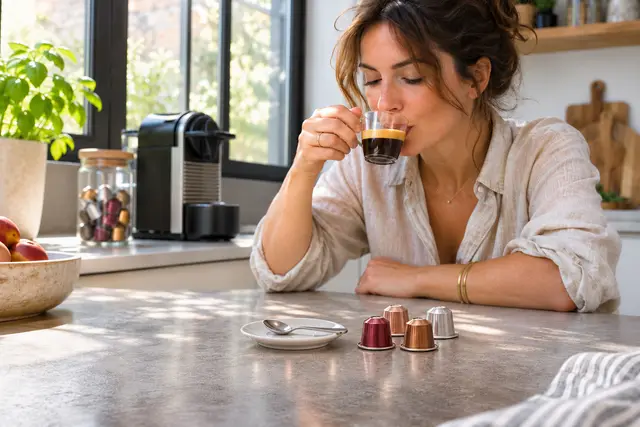
A coffee pod machine with adjustable cup size lets you choose the quantity of water that passes through the pod, and therefore the length of the drink: a small ristretto, a standard espresso or a long coffee. A counter measures the flow or the running time, then the appliance stops the pump at the programmed dose. It is aimed at those who like to vary the strength of their coffee, use cups of different sizes or share the appliance, each person storing a preferred volume without having to stop the extraction by hand.
What the volume changes
One and the same pod gives different drinks depending on the amount of water. A short volume, around 25 to 30 ml, produces a concentrated ristretto, syrupy and not very bitter. A standard espresso is around 40 ml. A volume of 100 to 120 ml gives a long coffee, gentler and lighter in the mouth, but also more bitter if the extraction goes on, because the water ends up dissolving less pleasant compounds.
Volume is therefore a way of adjusting strength without changing the coffee or the grind.
Measuring systems
Some appliances count the pulses of a flowmeter fitted on the water circuit. Others, simpler, time how long the pump runs. The flowmeter is more accurate, because it takes into account the wear of the pump and the resistance of the pod. Timing gives volumes that vary with the temperature and the packing of the coffee.
The dose buttons
Many appliances offer two or three buttons: a short cup, a long cup, sometimes a manual mode. The user can reprogram them by holding the key during the flow and releasing it at the desired volume.
Programming your volume step by step
- Place a pod and a cup under the spout.
- Hold the programming key until the sound or light signal.
- Let the coffee flow until the quantity you want.
- Release: the dose is recorded.
- Test with a second pod and adjust if necessary.
The exact procedure is given in the leaflet, because it varies from one model to another. It is useful to measure the quantity obtained with a small measuring cylinder, to have a real value rather than an assumed one.
Matching the volume to the type of pod
A pod is designed for a target volume, indicated by the manufacturer or guessed from its grind. A fine, dense coffee supports a short volume. A coarser coffee tolerates a longer one. Going noticeably beyond the intended volume gives a drink that loses its balance. For a longer coffee without bitterness, it is better to make an espresso and then add hot water separately, in the manner of an American-style long coffee.
Volume and cup
The cup should match the volume: an espresso cup of 60 to 90 ml for a short coffee, a 150 ml cup for a long one, a mug for a milky drink. A small volume in a large cup cools quickly and loses its crema. Conversely, a large volume in a small cup overflows. Adjusting the height of the spout, where the appliance allows it, limits splashing.
Memory and several users
In a household, everyone has their habits: one drinks a ristretto, another a long coffee. Appliances with several volume memories avoid reprogramming. A model with user profiles is useful in an office. Failing that, the settings can be noted on a label stuck to the appliance. After a power cut, some appliances recover their settings, others go back to factory values; the leaflet specifies this point.
Water and energy consumption
A longer volume uses more water and slightly more energy, because more has to be heated. The difference per cup remains modest. Precise programming does, however, prevent the waste of an overfilled cup that ends up in the sink, a common occurrence when the cycle is stopped too late.
Upkeep
A volume counter is sensitive to limescale: a deposit in the pipework falsifies the measurement and leads to doses that are too short or too long. Regular descaling maintains accuracy. It is recommended to make a check measurement after each descaling operation. The pod holder, the spout and the tray are cleaned after every use.
Common faults
- Irregular volume: check for limescale and how the pod is seated.
- Coffee too diluted: reduce the volume or change the pod.
- Stopping too early: the flowmeter may be clogged.
- Setting lost: redo the programming and consult the leaflet.
Safety
The drink and the pod holder are scalding. Wait until the flow has finished before removing the cup, and do not start a cycle with an unstable container. Children stay away from the appliance, because the lever and the spout stay hot for a long time.
Price
An appliance with adjustable volume costs a little more than a fixed-dose model. The difference is justified if you like variety or share the appliance, because it avoids wasting coffee. For a drinker of only one type of coffee, a fixed-dose model well set at the factory is enough.
Sorting and waste
Used paper pods can often be composted, subject to the agreement of the local authority; the grounds enrich a home compost heap. Appliances beyond use are taken to a collection point for small electrical appliances.
Alternatives
A capsule machine with pre-recorded programmes offers volumes suited to each capsule, with no handling. A manual espresso machine gives total control, with the barista's technique. A filter coffee maker produces large volumes, but without the character of an espresso.
Choosing well
Favour an appliance that measures flow rather than time, offers at least two storable volumes, and whose spout can be adjusted in height. Legible buttons, an end-of-cycle indicator and a drip tray that is easy to empty simplify daily use. The ability to reset the settings without complicated handling is a welcome asset.
Tasting tips
To find your ideal volume, make several cups with the same reference pod, at 30, 40 and then 60 ml, letting the appliance cool between each trial. Note what you perceive: sweetness, acidity, bitterness. Many people discover that a volume slightly shorter than the one they were using gives a rounder, more aromatic coffee. This small exercise, repeated with each new pod, helps to build a lasting profile of settings.
Reference volumes by drink
To find your way, a few orders of magnitude are useful. A ristretto is around 20 to 30 ml, an espresso around 30 to 40 ml, a long coffee 80 to 120 ml. A milky drink uses a short espresso, because the milk dilutes the taste. These guidelines are indicative: they vary according to local habits and traditions, between the short coffee of Latin countries and the longer coffee enjoyed elsewhere.
Why is my coffee shorter than the programmed volume?
The crema takes up part of the volume shown in the cup. A dose measured on the liquid alone will seem smaller once the crema has formed. It is better to measure in the same container and under the same conditions at each trial.
Tidying and cleaning after programming
Once the volumes are saved, the appliance simply needs to be looked after as usual. A soft cloth is enough for the buttons, because moisture can damage the electronic contacts. Avoid abrasive products and direct jets of water on the control panel, which risk damaging the markings and letting water into the circuit board.
If the display does not react after a manipulation, unplug the appliance for a few minutes and plug it back in, before starting the programming again from the beginning by following the leaflet.
Finally, it is wise not to set a volume greater than the capacity of the smallest cup in the household, in order to avoid any overflow and any accidental burn.