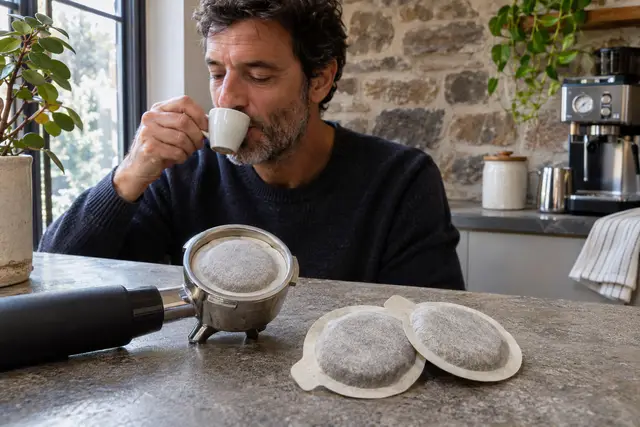
Deciding which machine for ESE pods really means finding a pump-driven appliance able to take a forty-four millimetre disc of filter paper holding ground, tamped coffee. This standardised dose, open to many roasters, lets you make an espresso without dosing or tamping anything yourself. The choice depends on the pump pressure, the temperature regulation, the presence of a steam wand, the size of the tank and the budget available for both the purchase and the doses. Getting this choice right is the first step towards a reliable everyday espresso.
Recognising an appliance truly designed for this format
An espresso prepared with an ESE dose requires an appliance that puts the water under pressure. Filter coffee makers and soft pod machines, which work with almost no pressure, should therefore be ruled out straight away. Look for the ESE mention on the data sheet or, failing that, the words "44 mm pods", and check for a pump rated in bar.
A fifteen-bar pump is frequently advertised, but that is a maximum power figure. What matters for extraction is the effective pressure at the dose, which sits at around nine bar on a well-adjusted appliance. An appliance that merely claims "high pressure" with no further detail deserves a careful read of the manual.
Dedicated machines and mixed filter-holder machines
Two broad categories meet the need. Dedicated ESE machines have a housing designed for the paper disc and accept nothing else: they are simple, quick and very consistent from one cup to the next. Mixed filter-holder machines, inherited from traditional espresso, let you switch from ground coffee to the ESE dose by means of a suitable filter.
The second category appeals to anyone who wants to keep some freedom, for example grinding their own coffee one day and using a pod the next. In return, it takes a little more practice: the pod filter must be rinsed, dried and stored properly to avoid leaks.
Flow rate, temperature and consistency
A good espresso from an ESE dose runs for about twenty seconds for a cup of roughly thirty millilitres. If the coffee comes out in a few seconds, the water is passing too easily; if it drips for a long time, the pressure is too high or the dose too tight. A machine able to reproduce this flow from one cup to the next is a good sign of quality.
The water temperature, close to ninety degrees at the point of contact with the coffee, is just as important. Thermoblock appliances stabilise it faster than single-boiler models, but the latter keep better thermal inertia when several cups are made one after another.
Boiler, thermoblock and steam
Water heating relies on two technologies. The thermoblock heats the water on demand, which cuts the waiting time and the consumption. The boiler stores water that is already hot, which offers more stability but requires a longer warm-up.
If you like milky drinks, check for a steam wand. It lets you heat and froth the milk for a cappuccino or a latte. Without a steam wand, you will have to make do with milk heated separately, which changes the pleasure of the cup.
Tank, size and available space
A tank of under one litre means filling it often, whereas a tank of a litre and a half is enough for a household of several coffee drinkers. Choose a model whose tank is removable and easy to clean, because standing water encourages limescale and off-flavours.
Measure the available height too: a pump machine with a filter holder needs the handle to be able to swing forwards. Also allow for the height of the cup under the spout, since some machines call for small espresso cups.
Budget and value for money
For home use, an entry-level appliance is enough to prepare a decent espresso from ESE doses. The costlier models mainly bring better temperature regulation, a sturdier frame and more pleasant everyday comfort.
The price of the doses should be counted from the outset. Since the ESE format is open, many roasters offer it, which lets you compare, mix origins and limit the annual spend. This freedom is one of the real strengths of the system.
Maintenance, descaling and lifespan
Regular descaling is the condition for a long life. Do it once a quarter in a hard-water region, a little less often elsewhere, using a suitable descaler and following the appliance's instructions. Then rinse thoroughly before making the next coffee.
After each use, remove the spent dose, rinse the filter holder and wipe the gasket. A clean gasket stays supple longer and guarantees a watertight seal. If the gasket hardens or cracks, it is easily and cheaply replaced.
Mistakes to avoid
The first mistake is to choose on the maximum pressure figure alone. The second is to ignore the usable height under the spout, which limits the cups you can use. The third is to buy without checking the availability of doses near home or online.
One last common mistake is to force a dose of another format into the housing. A damaged gasket, a leak on the worktop or a burst dose are the usual consequences. Respect the diameter given in the instructions.
Noise, comfort and ergonomics
The vibrating pump of an espresso appliance makes noise for about fifteen seconds. On some models, rubber feet and a better-damped frame noticeably reduce the nuisance, a welcome detail in a kitchen open to the living room or early in the morning.
Look as well at how easy it is to fill, the height of the drip tray, the presence of a large-capacity collecting tray and the legibility of the indicator lights. An appliance that is pleasant to handle is used more often, and so is better maintained.
Safety and good practice
A pressurised machine heats water to a high temperature: never loosen the filter holder during extraction, and wait for the pressure to drop. Keep the steam wand away from hands and children, because steam causes severe burns.
Place the appliance on a stable surface, away from an open water source, and unplug it during descaling or in the event of a leak. Use fresh water at each refill and empty the tank if the appliance stays unused for several days.
Finally, never leave the machine heating without water: the heating element risks overheating and the pump risks damage. Most recent models switch the heating off by themselves when the tank is empty, but it is best not to rely on that.
Sorting used pods
An ESE dose consists of filter paper and coffee grounds. If the envelope is free of plastic, it generally goes with the food waste or into the compost heap, depending on your council's guidance. The individual sachet that protected the dose in principle follows the plastic packaging stream, but the rules vary from one area to another.
Frequently asked questions
Does an ESE dose give a true espresso?
Yes, provided the machine delivers sufficient pressure and water at the right temperature. The dose, already ground and tamped, standardises the extraction and removes any need to adjust the grind.
Do you need a steam wand?
It is useful only if you drink milk-based drinks. For pure espresso or for coffee lengthened with hot water, it is not essential.
Can you make a long coffee?
Yes, by pouring hot water over the espresso, or by using the long-cup button where there is one. The taste remains more concentrated than with a soft pod.