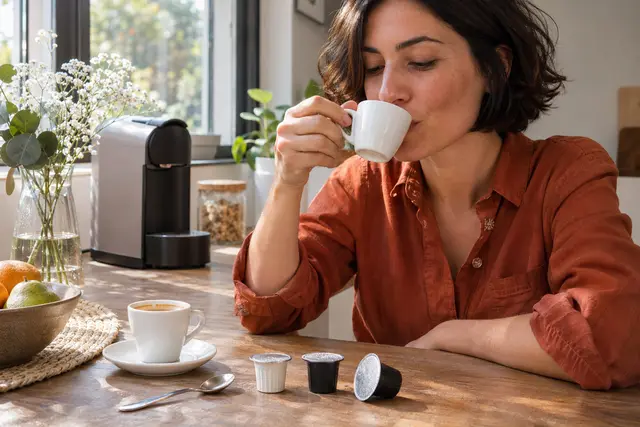
To use a coffee pod without a machine means preparing a drink with a soft pod when no pressure appliance, such as an espresso machine, is available. Each one carries roughly seven grams of roasted grounds sealed in a paper filter. You can infuse it in a cup, open it to pour the coffee into a plunger pot or a manual filter, or place it in the basket of an ordinary coffee maker. The result is lighter than an espresso, but perfectly drinkable.
Why the pod works even without a machine
The pod is only a portion of ground coffee housed in filter paper. All that is needed to extract the flavour is hot water and time. Pod machines add pressure, which gives the crema and the concentration of an espresso. Without this pressure, you get more of an infusion, close to a filter coffee.
You therefore need to adjust your expectations: the result will be less full-bodied, paler and without a true foam, but faithful to the taste of the coffee chosen.
Method 1: infusing directly in a cup
Put the pod in a cup, pour in hot water, but not boiling, and cover for a few minutes. The paper lets the water through and holds back the grounds. Press the pod gently with a spoon to draw out a little more flavour, then remove it before drinking.
This method recalls infusing a tea bag. It suits an emergency, at the office or on a trip. The coffee stays light and slightly less aromatic than with extraction under pressure.
Method 2: the plunger pot
In a plunger pot, you can open the pod with clean scissors and pour the ground coffee into the jug. Add hot water, leave to infuse for a few minutes, then push the filter down. The coffee is stronger than with a cup infusion, because the contact with the water is more complete.
The grind of a pod is fine, so a little sediment remains in the cup. You can let it settle before drinking.
Method 3: the manual filter or the filter coffee maker
Open the pod, pour its contents into a paper filter set on a filter holder, then pour the hot water in slow circles. In an electric filter coffee maker, you can also place one or two whole pods in the basket. The water then runs through the coffee by gravity.
The fine grind slows the passage of the water; watch the flow to avoid overflow. The result is a long coffee, light and rather mild.
Temperature and infusion time
Water that is just trembling, without a rolling boil, extracts the best from the coffee without burning the aromas. Allow between three and four minutes of infusion in a cup, a little less for a very fine coffee. Too long gives a marked bitterness.
Preheat the cup with a little hot water, which you then throw away, to stop the drink cooling too quickly.
Amount of water and dosing
A pod of about seven grams is designed for a small cup. For a longer coffee, you can use two pods rather than dilute, so as to keep the flavour. Too large a volume of water makes the coffee watery, too small a volume makes it bitter.
Start with a medium-sized cup, taste, then adjust both the amount of water and the contact time.
What cannot be reproduced
The thick crema, the concentration of an espresso and the constant extraction temperature cannot be reproduced without pressure. Some manual lever accessories claim to come close, but they go beyond the simple use of the pod. So accept a filter-type coffee, appreciated for its mildness.
For a white coffee, this result is perfectly suitable, because the milk masks the difference.
Safety and hygiene precautions
Hot water burns: pour slowly, hold the container away from your face and keep children away. Open the pod with clean scissors, on a clean surface. Do not use a pod whose packaging is damaged or whose smell is unusual.
The paper of the pod is intended for hot food contact; do not boil it for a long time in a saucepan, because it tears and releases the grounds.
Tips for a better result
Filtered water gives a cleaner coffee. Use fresh, well-kept pods. Do not reheat a coffee that has already been made, which turns bitter. Finally, rinse the cup or the pot straight away so that the grounds do not dry on.
If in doubt about the compatibility of a coffee maker, consult the appliance's instructions before putting a pod in it.
Travelling and camping
When travelling, the pod has an advantage: it needs neither a grinder nor scales. With a stove, a saucepan and a cup, you can make a coffee in a few minutes. Carry the pods in a rigid box to stop them being crushed, and keep the sachets away from the damp of the tent or the bag.
A small folding filter in silicone or metal, set on the cup, makes pouring the water easier and holds back the grounds. It packs flat and is easily added to a bag.
At the office without an appliance
In a place with no machine, a kettle and a cup are enough. Direct infusion gets you out of trouble in a few minutes, with no special equipment. Provide a saucer or a small plate to put the used pod on without staining the worktop.
A flask of hot water, prepared in the morning, lets you serve several cups on the same principle, as long as you rinse the cup well between drinks.
What to do with the grounds and the used pod
The used pod goes in the household rubbish or, if the paper is compostable and the local authority accepts food waste, in the suitable bin. The opened grounds can be composted or thrown away; they also suit the care of certain plants, in small amounts, after drying. Check your local sorting rules before choosing.
Frequently asked questions
Can you make an espresso without a machine?
Not really: espresso needs a pressure that only a machine or a lever appliance provides. What you get is rather a concentrated filter coffee, by reducing the volume of water.
Can the pod tear in the cup?
Rarely, if you handle it with care. A good-quality pod stands up to an infusion of a few minutes, but pressing too hard can split the paper and release grounds.
Can a pod be reused?
A second infusion gives a very weak and more bitter coffee. It is better to use it just once for a decent result.
Iced coffee with a pod
The infusion method also suits cold coffee. Leave the pod to steep for several hours in cold water, in the fridge, in a closed container. You get a smooth, low-acid drink, served over ice cubes. Time replaces heat: the longer the infusion, the richer the coffee, but avoid going beyond one night to limit bitterness.
Drink it within the day and keep it cold, like any perishable food.
Choosing a pod suited to infusion
Pods whose paper is thick and well sealed stand up better to infusion. A slightly coarser grind releases fewer fine particles into the cup. Mild, fruity coffees come out well in a long infusion, whereas a very strong coffee easily gives a bitter drink.