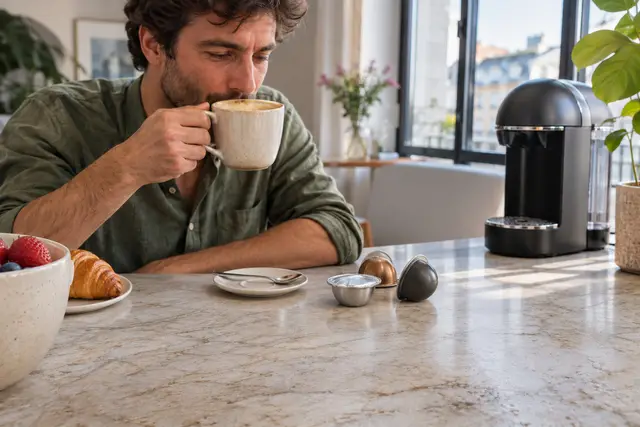
An organic coffee pod is an individual portion of ground coffee whose beans were grown according to the specifications of organic farming. This rules out synthetic pesticides and chemical fertilisers as well as genetically modified organisms. The product is inspected by an independent body, from the plantation to the packaging, and then receives the European logo. Placed in a pressure machine, the paper portion is prepared like any other. It interests consumers who care about growing methods and the environment of the producers.
What the word "organic" covers
In the European Union, this term is protected by a regulation. It may appear on a product only if the product complies with precise rules of production, processing and labelling. For coffee, this concerns the growing of the coffee tree, the harvest, the drying, the storage, the roasting and the packaging, all of which must be monitored and documented.
A coffee sold as organic is not for all that a product "without traces". Air, water and neighbouring plots can leave minimal residues. The regulation therefore sets procedures to limit contamination and penalties in the event of breaches.
The specifications on the plantation
The producer gives up herbicides, insecticides and synthetic fertilisers. To fertilise, he or she uses compost, coffee pulp waste, green manures or animal manure. To limit disease, the grower favours plant diversity, the shade of associated trees and the rotation of care, rather than chemical treatments.
Converting a conventional plantation takes several years. During this period, the coffee cannot be sold with the organic label, which represents a financial effort for the producer. This is one of the reasons for the higher price of these products.
The logos to recognise on the box
The European logo, a leaf formed of stars on a green background, is compulsory on pre-packaged products from organic farming. Beside it you find the number of the inspection body and an indication of the origin of the raw materials, for example "EU agriculture" or "non-EU agriculture". The French national logo, when it appears, is optional.
The presence of another label, such as those concerning fair trade or agroforestry, has nothing to do with the organic logo. Each mention must be checked separately, because a product can be organic without being fair trade, and the reverse.
The taste of a coffee grown without chemical inputs
The method of cultivation does not by itself determine the flavour. The beans depend on the species, the altitude, the soil, the post-harvest treatment and the roast. An organic coffee can therefore be excellent, ordinary or disappointing, like any coffee. It happens that producers who care about their soils are also attentive to the quality of the bean, but this correlation is not systematic.
To judge a product, taste it with the same machine, the same water and the same cup as a conventional coffee, and note the differences. The result is a matter of personal taste, not of the label.
Preparing the portion and storing it well
The preparation follows the rules for all espressos: water at about ninety degrees, pressure of nine bars, extraction of twenty to thirty seconds. Lay the portion flat, lock the portafilter and stop when the cup is full. No special setting is needed.
Storage needs a little attention, because some organic coffees are roasted in small batches and without preservative additives. A closed box, kept dry and away from light, lasts several months. An opened box is used within a reasonable time.
Price: why it is higher
Yields are often lower, labour greater and certification costs are added. Small producers have to pay for inspections and keep records, which is a real burden. These extra costs are reflected in the price of the box, with a gap that varies from one brand to another.
To stay reasonable, compare the price per portion rather than per box. Large packs, well stored, make it possible to reduce the unit cost, provided you use them before the best-before date.
Packaging and sorting
The label does not cover the packaging. A portion can be organic and enclosed in a non-recyclable plastic or metallic film. Some manufacturers offer compostable papers and certified cartons, which extends the ecological approach, but this is not an obligation.
Coffee grounds and untreated filter paper compost. The cardboard is sorted with paper, and plastic films follow the municipality's instructions. In case of doubt, the label or the manufacturer's website states the appropriate sorting route.
Inspection from end to end
Every operator in the chain, from the producer to the roaster by way of the importer and the packer, must be inspected by an approved body. The body checks the plots, the growing records, the stocks and the invoices, and may take samples for analysis. An annual certificate attests to the compliance of each party.
Imports from third countries follow a regime of equivalence or compliance. The coffee must then be accompanied by an electronic certificate of inspection, which makes it possible to trace the route back. It is this system that gives meaning to the indication of origin printed on the box.
A coffee for whom, and for what reasons?
Buyers' motivations vary: a wish to reduce the use of chemicals in growing areas, concern for the health of farm workers, a preference for human-scale supply chains, taste curiosity. None is superior to the others, and everyone chooses according to their priorities.
For those who wish to go further, a comparative tasting between an organic product and a conventional one, at the same level of price and roast, brings concrete insight. It shows that it is better to judge a cup than to rely on a label alone.
Combining the organic label with other approaches
Some producers combine organic cultivation with shade growing, the preservation of biodiversity and pay above the market price. These commitments are added to the European specifications and are sometimes attested by private labels. They strengthen the credibility of the approach, provided the criteria are public and verifiable.
Reading the label carefully is often enough: mention of a cooperative, the name of a region, details on the drying or the variety. Conversely, a box that is content with big words and no precise facts calls for caution, because the logo alone says nothing about other practices.
Myths about organic coffee
No, it does not guarantee the absence of caffeine, a superior taste or better pay for the producer. It guarantees above all a method of cultivation and an inspection. No, it is not a health product either: its nutritional composition remains that of an ordinary coffee.
One last remark concerns roasting: the regulation governs the ingredients, but not the degree of roast. An organic coffee can therefore be as light as it is very dark. For a mild drink, choose a light or medium roast indication, and for a powerful cup, a dark one, exactly as for an ordinary coffee.
Is an organic coffee always fair trade?
No. The two approaches are independent. A product can carry both labels, but they meet different criteria.
Where can organic portions be bought?
In specialist shops, in supermarkets, in a roaster's shop or online. The European logo must always appear on the box.