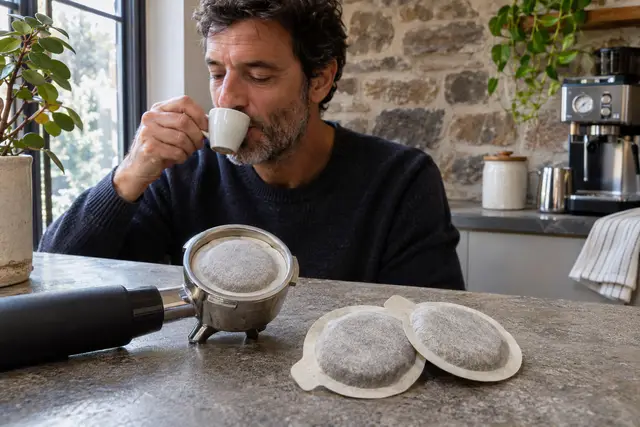
An ESE 44 mm coffee pod is a disc of ground coffee, pressed between two sheets of filter paper, whose standardised diameter is forty-four millimetres. The letters ESE stand for Easy Serving Espresso, an open standard that several roasters and machine makers can use. It holds about seven grams of coffee, the amount for one espresso, and slips into a portafilter or a dedicated housing. It suits those who want a consistent espresso, without measuring or tamping the coffee, and with little cleaning afterwards.
An open standard born in Italy
The ESE format appeared in the late 1990s to simplify espresso at home. Several Italian players in coffee and machinery agreed on common dimensions, so that the same pod could work in appliances from different brands. The ESE logo, printed on the packaging, signals this compatibility.
Unlike rigid capsules, often tied to a closed system, the forty-four millimetre paper pod belongs to no manufacturer in particular. This openness explains the great variety of coffees on offer, from light roasts to full-bodied blends, and the possibility of changing supplier without changing machine.
Dimensions and construction of the disc
The forty-four millimetre diameter is the central fact, repeated in the name of the format. The disc is a few millimetres thick, which gives it the shape of a small puck. The coffee is lightly compressed inside: the tamping is enough for the water to pass through evenly, without being so firm that it blocks the pressure.
Two sheets of filter paper wrap it and are sealed around the edge. The paper lets water through and holds back the grounds, which avoids clogging the machine's group. The weight of ground coffee is around seven grams, a value that can vary modestly depending on the roaster.
Compatible machines
Three main families of machine accept this format. The first are dedicated pod machines, whose housing is calibrated for a diameter of forty-four millimetres. The second are portafilter espresso machines, to which you add a suitable basket or an adaptor that takes the pod. The third are certain combination machines, able to handle both pods and ground coffee.
Before buying, check in the instructions that the housing carries the mention of the ESE standard. Do not confuse it with soft pods of about seventy millimetres, which are used in other types of appliance and do not fit an espresso portafilter.
Making an espresso with an ESE pod
Place the disc in the centre of the housing, lying flat, without folding or piercing it. The portafilter is then locked onto the machine, which has been left to heat up. The water passes under pressure through the disc in about twenty seconds, and the espresso flows into the cup with a golden crema.
The result depends on the state of the seal, the cleanliness of the portafilter and the temperature of the water. A well-centred pod produces an even extraction. If the coffee comes out too fast or drips with difficulty, check the positioning, the freshness of the pod and the cleanliness of the grid.
Grind, freshness and taste
The grind is calibrated by the manufacturer for a rapid extraction under pressure: it is fine, comparable to that of a classic espresso coffee. It cannot be adjusted, which is the main appeal of the format but also its limit for those who like to tinker with settings.
Ground coffee goes stale quickly in contact with air. For this reason, the pods are packed individually or in batches, in a sealed barrier sachet, sometimes under a protective atmosphere. The volatile aromas thus remain available for several months, as long as the packaging is not opened. Once exposed to the air, it is better to use the pod within the following days.
Storage at home
Keep the pods in their original sachet, well closed, in a dry, cool place away from light. The fridge is not recommended: it exposes the coffee to moisture and smells. An airtight jar is suitable if the packet has already been opened.
The best-before date remains the reference. Beyond it, the coffee is not dangerous in itself but loses aroma and crema. A pod that is damp, misshapen or smells rancid should be discarded.
Grounds, paper and sorting
A used pod contains grounds and two sheets of filter paper. In most cases, the whole can go to the compost heap or the food waste bin, because the paper breaks down with the grounds. You should still read the packaging: some seals use fine plastic fibres, which do not degrade.
The individual wrapping, often a flexible film sachet, is sorted according to the local council's instructions. Coffee grounds can also serve as a light fertiliser in the garden, provided they are spread in a thin layer. Nothing should be thrown down the sink, where the grounds risk blocking the pipes.
Price and alternatives to the ESE format
The cost per cup of an ESE pod generally falls between that of ground coffee and that of branded rigid capsules. The advantage lies in freedom of choice: several competing roasters sell interchangeable pods, which encourages comparison.
The alternatives are ground coffee, which gives a choice of dose and grind but requires tamping, aluminium capsules, which are more closed, and refillable capsules, which you fill yourself. Each option is chosen according to the time available, the budget and the importance given to a consistent cup.
Forty-four millimetre pod or soft pod
Two paper formats coexist on the market and are easily confused. The soft pod, wider, slips into low-pressure appliances, where water percolates through a loosely packed coffee and gives a long drink with a light foam. The forty-four millimetre disc, denser and narrower, is made for water passing under high pressure and gives a short, concentrated espresso topped with crema.
The difference therefore lies as much in the machine as in the pod. Putting a narrow disc into a housing meant for a wider format lets water pass down the sides, and the extraction turns into coloured water. Conversely, a pod that is too wide does not close properly. Checking the dimensions with the instructions in hand avoids these inconveniences.
Common mistakes and remedies
The first mistake is to place two pods in the same basket to get a stronger coffee: the pressure rises, the extraction becomes uneven and the coffee flows badly. You get a better result by choosing a fuller-bodied blend than by doubling the dose.
The second is forgetting to clean the portafilter: residues of coffee oil go rancid and give the next cup a bitter taste. A rinse in hot water after each use is enough, supplemented by a regular wash. The third is not preheating the machine enough: water that is too lukewarm gives a sour espresso with no crema. Letting the machine reach its temperature and running a little water through empty clearly improves the result.
Maintaining the machine and the housing
The pod housing must stay clean and dry between uses. A soft brush removes the small grains of grounds that lodge in the grid. Periodic descaling of the machine, with a suitable product or citric acid, protects the boiler and keeps the water temperature up.
Depending on the hardness of the local water, the descaling frequency varies: the harder the water, the more often you need to descale. Filtered water slows the build-up, without eliminating it. The appliance's instructions give the recommended interval and the products to avoid, notably neat vinegar, which can damage certain seals.