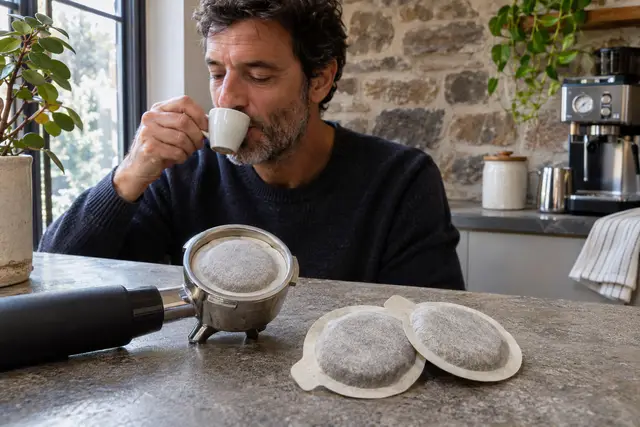
Soft coffee pod vs ESE pod machines pits two families of appliances that brew from doses pre-packed in filter paper. The soft pod, wide and domed, gives a long coffee at low pressure. The ESE pod, forty-four millimetres across, produces an espresso under high pressure. These machines suit home users who want a consistent cup without grinding or dosing, with little cleaning, few steps and a controlled cost per cup. Each is a distinct way of making everyday coffee, so the right choice depends on taste, budget and space.
Two philosophies of preparation
Both appliances start from a shared idea: replacing the manual dosing of ground coffee with a pre-weighed dose sealed in a filter-paper envelope. Yet the way each machine treats that dose is profoundly different. The soft pod machine works at low pressure, on a principle close to an accelerated filter coffee maker: hot water passes through the dose, picks up the aromas and runs into the cup within a few dozen seconds. The ESE pod machine belongs to the family of pump-driven appliances, designed to reproduce a bar-style espresso.
This difference in design explains almost everything else: the flavour, the size of the cup, the price of the appliance, the noise level and even the space taken up on the worktop. Before comparing point by point, bear in mind that these are not two versions of the same product, but two distinct ways of approaching everyday coffee.
Water pressure and temperature
The soft pod makes do with very low pressure, in the order of one to two bar depending on the model, supplied by a small pump or simply by the heating of the water. The reservoir is heated to around 90 to 95 °C, which is enough to extract a long, round coffee without harshness. The lid of the machine closes over the dose, and an injection tube pierces it lightly to let the water through.
The ESE pod demands more. To obtain an espresso, the pump must climb towards nine bar, the benchmark figure of classic Italian preparation. The filter holder or housing must therefore be perfectly watertight, and the appliance must hold that pressure steadily for the fifteen seconds or so that the extraction lasts. A truly accomplished ESE machine also regulates the temperature of the boiler or thermoblock to avoid a burnt coffee or, conversely, one that is too lukewarm.
Flavour and texture in the cup
The result in the cup is the criterion that separates the two families most clearly. With a soft pod, the coffee is long and light, with a fine foam on the surface produced by a built-in air-assisted spout. The body remains modest, the bitterness is low and the cup is often drunk generously filled, at around one hundred and twenty to one hundred and forty millilitres.
With an ESE pod, you get a short, concentrated espresso topped with a thicker, longer-lasting crema. The grind is finer and more tightly packed in the paper, which offers more resistance to the water and brings about that dense extraction. Lovers of strong coffee, of ristretto or of a base for a cappuccino will find a profile closer to the bar, whereas drinkers of long coffee prefer the softness of the soft pod.
Purchase cost and cost per cup
On the price of the appliance, the soft pod machine is generally the cheaper of the two, because its mechanism is simple: a reservoir, a heating element, a small pump and a lid. It is often found at an entry-level price, which makes it a sensible first purchase for a household, an office or a second home.
The ESE machine costs more to buy since it carries a high-pressure pump, a sturdier hydraulic circuit and sometimes a steam wand. In return, the choice of pod suppliers is wide, because the ESE standard is open and shared by many roasters. This competition pulls the price per cup downwards, often to a level comparable to, or even lower than, that of the soft pods sold in supermarkets.
Maintenance and lifespan
Both systems share an advantage over loose ground coffee: there are no grounds to tamp and no filter to clean in depth. You simply remove the used pod, throw it away and rinse the spout. Descaling, on the other hand, remains essential for both, at a frequency that depends on the hardness of the local water.
The soft pod machine, being very simple, rarely suffers a serious breakdown, but its lid seal wears with time and can let water leak. The ESE machine, which is more complex, needs a filter-holder gasket in good condition and a well-maintained pump. An appliance of decent quality can last many years provided it is descaled regularly and is not left to heat up while empty.
Size, speed and noise
The soft pod machine is compact, quiet and ready in under a minute after switching on. It suits narrow kitchens and shared workstations well. Its light frame also makes it easy to tuck away in a cupboard between uses.
The ESE machine is a little bulkier, heavier and noisier, because of its vibrating pump. It needs a slightly longer warm-up, sometimes two to three minutes, so that the circuit reaches its working temperature. Once hot, it turns out cup after cup at a brisk pace.
Which profile suits which appliance
To put it plainly: the soft pod suits anyone who wants a long, simple and economical coffee, with no settings and an almost automatic preparation. The ESE pod suits anyone looking for an authentic espresso, who accepts a slightly bulkier machine and wants to enjoy a wide choice of blends.
A household in which everyone drinks their coffee differently may find it worthwhile to choose an ESE machine, since it also makes a long coffee when hot water is poured over the espresso. The reverse is not true: a soft pod machine will never produce a true concentrated espresso.
Compatibility and common buying mistakes
A soft pod does not fit in an ESE machine, and vice versa. The diameters and the stiffness of the paper are not the same: the ESE dose measures about forty-four millimetres, whereas the soft dose is wider and more domed. Forcing a dose into the wrong housing damages the seal and causes leaks.
Before buying, check the format shown on the box of pods: the letters "ESE" or the words "soft pod" and the diameter in millimetres are the reliable markers. Be wary, too, of machines advertised as "universal" without further detail: they often use an interchangeable filter holder that has to be adapted to each format.
Sorting and recycling used pods
Both types of dose are made of filter paper enclosing coffee grounds. Provided the envelope is paper with no plastic or aluminium, it can generally go in the food waste bin or the home compost heap, depending on your local council's guidance. If in doubt, ask your local authority, because sorting rules vary from one area to another.
The plastic or cardboard outer packaging of the box follows the usual household packaging stream. There is no need to rinse the pods before throwing them away, but let them cool first to avoid burns and condensation in the bin.
Frequently asked questions
Can you make a cappuccino with each type of machine?
With an ESE machine fitted with a steam wand, yes: the espresso serves as the base and the milk is frothed separately. With a soft pod machine, you get a long coffee that takes hot milk, but the foam stays light and is no substitute for a true cappuccino.
Is the ESE pod fresher than the soft pod?
Freshness depends above all on the sealed individual wrapping and on the roasting date, not on the format. A pod in a protective sachet keeps its aromas longer than a pod simply placed in a cardboard box.
Which machine is best for office use?
For a small office where people mostly drink long coffees, the soft pod machine is practical and inexpensive. If the team asks for strong coffee served quickly, an ESE machine will be more appreciated.